

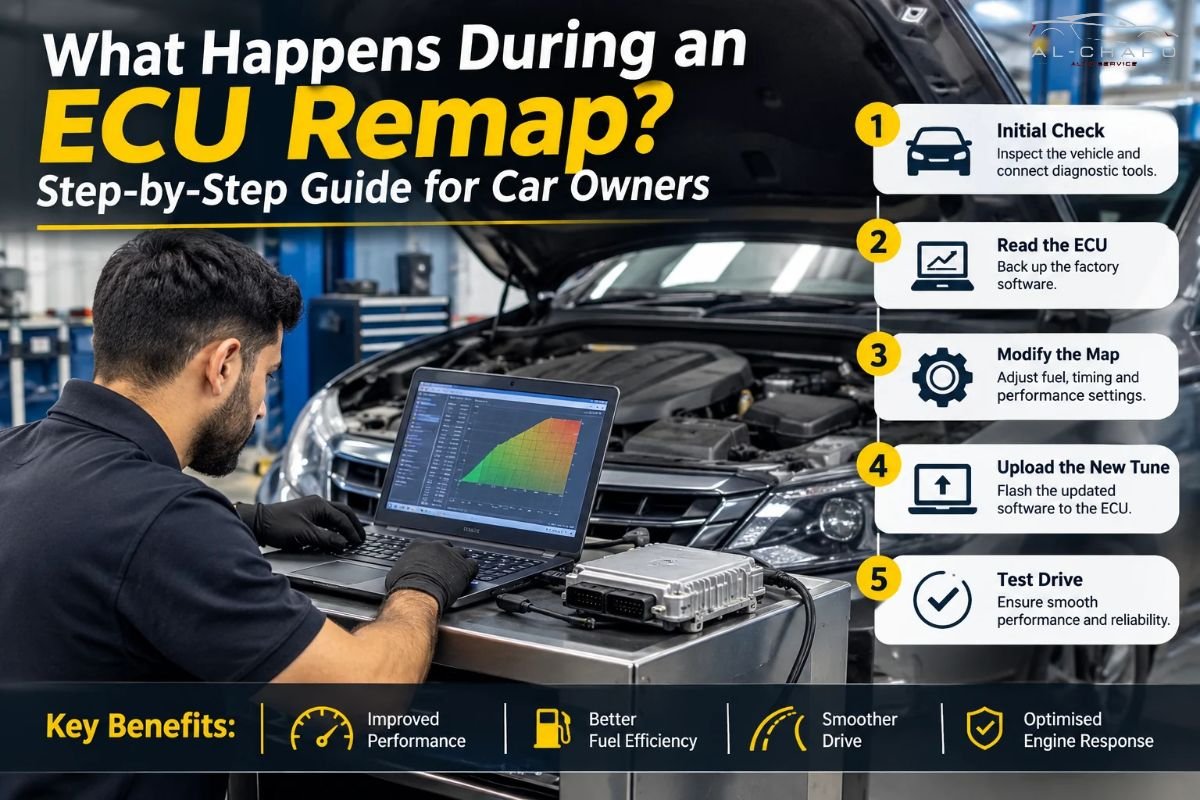
What Happens During an ECU Remap? Step-by-Step Guide for Car Owners
Table of Contents
- Key takeaways
- What is an ECU remap?
- What happens during an ECU remap: step by step
- Tools used during remapping
- Stock map vs. remapped map
- Benefits and risks to understand
- How to choose a provider in Dubai?
- Common mistakes to avoid before remapping
- Final thoughts
- Frequently asked questions
An ECU remapping alters the programming within the engine control unit so that the engine uses a different set of values. The technician assesses the condition of the vehicle, reads the original settings, creates a new map before installing it into the ECU, and finally road-tests the vehicle while recording information.
Usually, it takes only a few hours of the process for a regular diesel or petrol car. Vehicle owners wish to get improved throttle response, better acceleration, or efficiency; however, the results depend on both the engine and the quality of the work.
Key takeaways
- Remapping the ECU helps in changing the values in the chip software that regulate fuel, timing and boost, and that is why the car behaves differently.
- A correct remap starts with a complete diagnostic check of the vehicle, since hidden problems can become relevant when calibration occurs.
- The original ECU map must be preserved, since it plays an important role in recovering your car in case any maintenance work is needed in the future.
- Pick the garage that offers you a detailed explanation of the remapping process, keeps copies of remaps, and does not get involved in false promises.
What is an ECU remap?
The engine control unit, or ECU for short, is a mini computer located in your car and manages the way the engine operates. It gathers data from dozens of sensors, such as air intake, throttle position, oxygen, coolant temperature, crankshaft speed, and more. It then, based on these readings, determines the amount of fuel to inject, when to ignite the spark plugs, and what to do to balance emissions and performance.
These decisions are made deliberately. They are programmed by engineers at the manufacturer, based on huge sets of lookup tables, typically referred to as maps, that associate engine states with output values. Each map is optimized for emissions requirements, fuel quality assumptions, and reliability goals over a variety of climates and driving scenarios.
Why do owners look at remapping?
A compromise was the factory map. It must perform well in a car that is driven on cold mornings, hot afternoons, stop-and-go traffic, and long journeys over long distances, frequently on fuels that are of varying quality. Many owners experience that their vehicle doesn’t accelerate as sharply or as smoothly as it could, particularly in the middle part of the rev range.
However, one way of making that compromise is to remap. A trusted technician does not change the hardware, but rather adjusts the software values in order to alter the manner in which the engine operates. This is why many drivers in Dubai, a place with intense heat in summer and heavy traffic, inquire about remapping as a means to improve their driving experience on a day-to-day basis.
What happens during an ECU remap: step by step
Most all remaps are the same, but different according to the make, model and engine type. The following steps outline a step-by-step process of what a conscientious workshop does, all the way from the initial conversation to final handover.
Step 1: Consultation and Goal Setting
It begins with a discussion of what you want and how you’re going to use the car. A quality technician will ask you if you run errands in town every day, if you have a car to tow, if you drive off the roads on weekends, or if you do most of your shopping by car. Your answers affect the calibration, as a different type of car will be used for a different kind of event.
Therefore, it’s also the time to establish reasonable expectations. A remap can enhance the performance of the car, but it cannot make a small family car a performance car. A trustworthy workshop will be able to tell you what the likely results of a remap are, and when one is not suitable for your car.
Step 2: Vehicle Inspection and Health Check
The car must go through a comprehensive ‘health check’ before any software changes are made. Technician attaches a car diagnostic scanner that stores fault codes, live sensor info, and emission system status that the technician uses for the diagnostics. Misfires, faulty sensors, intake leaks, or any other fault detected here will be the cause of serious damage if the engine is remapped.
The inspection also addresses fundamental issues underpinning a remap. The performance of the engine in new settings is influenced by: spark plugs, air filter, fuel system condition, cooling system, oil level, and battery health. It’s much safer to perform a remap on a well-maintained car.
Step 3: Reading and Saving the Original Map
The car’s ECU is diagnosed using the same port as the diagnostics, and once it’s determined that the car is healthy, the original ECU file is read in through that port. The tool copies the factory calibration, and the workshop saves it as a backup. It is important to have a clean copy of the original file, as it will make it easier to return the car to its factory condition for warranty or future service.
At this point, many workshops take measurements to create a baseline. During normal operation, they record the engine speed, boost pressure, fuel trims, ignition timing, and intake air temperature. This baseline provides the team with a reference to measure the changes after the remap.
Step 4: Data Logging Under Real Conditions
The tech, before writing anything new, typically drives the car for a while, recording data. The objective is to observe the performance of the engine at varying loads, speed, and temperature. In Dubai, testing may take place with the air conditioning on and the cabin warm, as this has an impact on intake temperature and knock control.
Grounded in real-world data. It indicates where the engine can be safely stressed to greater output and where the current settings are already providing protection from stress. Otherwise, a tune would be based on assumptions and not on evidence.
Step 5: Writing the New Calibration
This is the fundamental part of the process. The technician fine-tunes such parameters as fuel injection amount, ignition timing, boost targets, throttle mapping, and gear-based torque limits using the baseline data and the original map. Every change is purposeful and small. When one value changes, it is likely that others will do so as well, and the work takes time and expertise.
Good calibration is a compromise between power, safety, and compliance with emissions regulations. Running the engine too rich, too lean, or too hot should result in a poor engine response. That is where a good tuner comes in to save the day; their hand can make the difference between a smooth finish and a rough or untrustworthy finish. This is where most of the quality is determined, and owners shopping around should inquire about it in detail.
Step 6: Flashing the New Software
After calibration and verification, the calibration is put into the ECU. The flashing process can be described as follows. The battery must have a constant voltage to the car, as a small drop in voltage can render the control unit inoperable. In many workshops, a battery charger is connected to the battery to maintain a steady voltage throughout the operation.
Once the flash is complete, the tech tests to make sure the new file has been accepted by the ECU, and loads the stored values back in to verify they are the same. Fault codes stored are erased, and the systems are restarted. Most owners can tell something is amiss in the car before the test drive.
Step 7: Road Testing and Verification
The calibration is on the road test that it proves. The technician drives the vehicle at various speeds, gears, and loads while watching live data. They check for knock, fuel trims, boost irregularities, or warning lights. If a problem is detected, it is fixed with minor changes to the file, and the car is re-flashed when necessary.
During the test drive, some of the conditions to check are city traffic, highway driving, and steady driving. Only one successful run is not sufficient. The goal is to make sure the engine works well under normal driving conditions that are experienced in practice every day.
Step 8: Final Checks and Handover
The last part is a review with the owner. A technician details the change, where applicable, provides before-and-after data, and provides any recommendations. This could involve running the same fuel grade the calibration was designed for, sticking to shorter oil change intervals, or testing boost hoses more frequently. A handover record should be kept that shows the file version, date, and reference to the saved original map.
It is also important for owners to understand what they can anticipate over the next several days. Engines learn, and the initial drives may be a little different until the car gets used to its new way of working. A good workshop is available for follow-up questions during this time.
Tools used during remapping
Professional remapping requires good equipment. The following are typical components of a workshop:
- OBD interface to get data from the car to the laptop.
- Calibration software that enables the technician to read, edit, and write the ECU file.
- A battery charger to maintain voltage when flashing.
- A car diagnostic scanner Dubai that technicians use to clear codes and check system health before and after the job.
Moreover, the quality of this equipment is as important as the skill of the user. If there are any software or interface issues, such as outdated software or interfaces that are not well supported, the file may be corrupted, and the ECU may not function. Discuss the tools used and ways to verify a correct flash is done with the workshop.
Stock map vs. remapped map
It’s important to know the distinction between the factory map and a remapped one so as to have realistic expectations. Here’s a basic overview in the table below. Actual results will vary with engine, calibration, and fuel.
| Area | Stock Map | Remapped Map |
| Throttle response | Tuned for smooth, gradual response | Adjusted for sharper, quicker response |
| Power delivery | Balanced for emissions and comfort | Often stronger in the mid-range, depending on the engine |
| Fuel economy | Set for standard driving | Can improve with gentle cruising, but may drop under heavy throttle |
| Warranty position | Original factory settings | Software changed, so check warranty terms |
| Reversibility | Not applicable | Original file usually saved for restoration |
| Engine stress | Within manufacturer margins | Depends on calibration quality and fuel grade |
The one thing the table says is that a remap alters the trade-offs, not add performance without any cost. Others prefer a more responsive response and are willing to pay for a little extra fuel consumption if the vehicle is harder to accelerate. Others consider economy and refinement. A good workshop enables you to determine your priorities before you write any file.
Benefits and risks to understand
Potential Benefits of a Remap
With a successful remap, a car can be more responsive, particularly when accelerating from a stop or accelerating past other cars. Some owners also experience improved gear changes and increased mid-range torque, making driving every day more enjoyable. For turbocharged engines, a well-calibrated boost curve can provide better overall performance throughout the rev range.
Fuel economy can also be improved, although this is not as predictable. Calibrating for a more sensitive throttle response and efficiency at cruising speeds can be useful when driving at constant speeds. If the new tune stimulates greater use of the throttle, however, fuel consumption could increase, and results will vary greatly based on driving style.
These are the primary reasons why drivers choose to go for a car engine tuning service Dubai has to offer that they can rely on. It’s about using the calibration that best suits your actual driving situation instead of looking for the top numbers on paper.
Risks Owners Should Weigh
Remapping puts a strain on an engine, especially if it is programmed to run with boost, timing, or fuel delivery limits that the stock parts were not intended to withstand. A good tune can be a costly issue due to poor fuel quality, worn components, and overheating. This is where the inspection prior to the job becomes significant.
Other factors to consider are warranty coverage. Engine fault claims may be denied if the software has been modified by some manufacturers, and the rules vary from manufacturer to manufacturer and region to region. Be sure to inquire with the workshop before booking if it has a policy on warranty issues and if it has original backups.
Documentation is also worthwhile to retain. A complete log of the work done, file version, and backup reference can make the vehicle easier to explain and easier to restore if necessary, if it is later inspected or sold.
How to choose a provider in Dubai?
The choice of workshop is as important as the choice of remap. A good supplier makes it very clear about the process, demonstrates they are checking the car and aren’t interested in doing a remap if it’s not necessary. When choosing the best car service center Dubai that you can trust, follow the checklist below.
A checklist for choosing a workshop
- If they intend to alter any software, ask if they do a full diagnostic scan first, out of respect for the condition of the engine.
- Verify that they maintain an original file backup, to make it possible to restore the car should a problem emerge in the future.
- Verify that they have experience with your car make, model, and engine type.
- Don’t browse for a promise of quick, significant gains in power; look for a clear statement of expected results.
- Inquire about any post-purchase support, such as warranty coverage and follow-up inspections within the first few weeks of driving.
Questions to ask before booking
When you are looking for ECU remapping services in Dubai, online or among friends, make sure to compare workshops. Look at how they each respond to your inquiries. If they don’t answer in detail or if they are in a hurry to make a decision, they are a warning sign, but patient explanations are generally signs of being well-prepared.
Talk to Alchapo Auto Service and have them take you through each step of this process, from diagnosis to finally handing you the keys. If they give you a clear explanation, you’ll learn a lot about what you can expect from their work.
Common mistakes to avoid before remapping
A lot of remapping issues are due to unnecessary decisions prior to the remap itself. Owning is not just about the price or the horsepower; it’s about the fundamentals that help an engine stay healthy. The following sections deal with the most common errors.
- Skipping the Inspection
One of the most expensive mistakes is not conducting a health check. If a car has any sort of fault in the ignition coil, or a small vacuum leak, that fault can magnify after the calibration requests more of the engine. An appropriate inspection is a small cost when compared with the cost of a damaged turbocharger or cylinder head.
- Choosing Price Over Quality
Choosing a car engine tuning service Dubai based on the lowest quote is likely to give you a poorly calibrated engine, no file backup, and no road testing. Inquire about the contents of the quote. A fair price should cover diagnostics, the calibration itself, flashing, and a proper test drive.
- Ignoring Fuel Quality
The quality of fuel directly influences the performance of a remapped engine. It is possible that certain calibration designed for a higher octane rating leads to knock if the remapped car is constantly refueled with lower-quality gasoline. The owner needs to check the type of fuel the tuners deem appropriate and use it as required.
- Forgetting Ongoing Maintenance
A remapped engine still requires thorough care, even if many owners treat it as an endpoint. Getting an oil change, checking the cooling system, and inspecting the intake become fundamental after the tune, because the engine works harder. Keeping a log is important to keep track of all changes and show your maintenance record to the workshop in case they have any questions.
Final thoughts
Remapping an ECU is a systematic process initiated by a discussion and the health check of the vehicle. It is followed by data logging and calibration. The task ends with flashing, road testing, and proper handover. If performed correctly, one can enjoy a more responsive drive depending on the type of engine, fuel used, and quality of the job. It is essential that one takes some time to ask questions about the process to make an informed decision whether to go for remapping or not.
If you are considering remapping, the first step is finding a reliable Car Service Center Dubai for the inspection and checking if the ECU remapping services in Dubai fit your car and your objectives.
Frequently asked questions
Standard remapping usually takes several hours, such as inspection, logging, flashing, and a road test, before returning to the owner.
Safe to do so if a qualified technician checks it out first, uses verified files, and keeps an original backup.
Depending on manufacturers’ policies, it is advisable to verify warranty conditions prior to making a reservation and save an original copy of the map.
Some owners have better fuel economy due to gentle cruising and tuning, while heavy throttle usage may consume more fuel. Results vary.