
What are the best car audio upgrades for improving sound quality?
Table of Contents
- Key Takeaways
- Why do factory sound systems fall short?
- Speakers: the upgrade that matters most
- Adding an amplifier for clean power
- Subwoofers and low-frequency balance
- Sound deadening: the upgrade nobody talks about
- Head units and digital signal processing
- Comparison table: upgrade priority by budget
- Common mistakes to avoid
- Wrapping it up
- Frequently asked questions
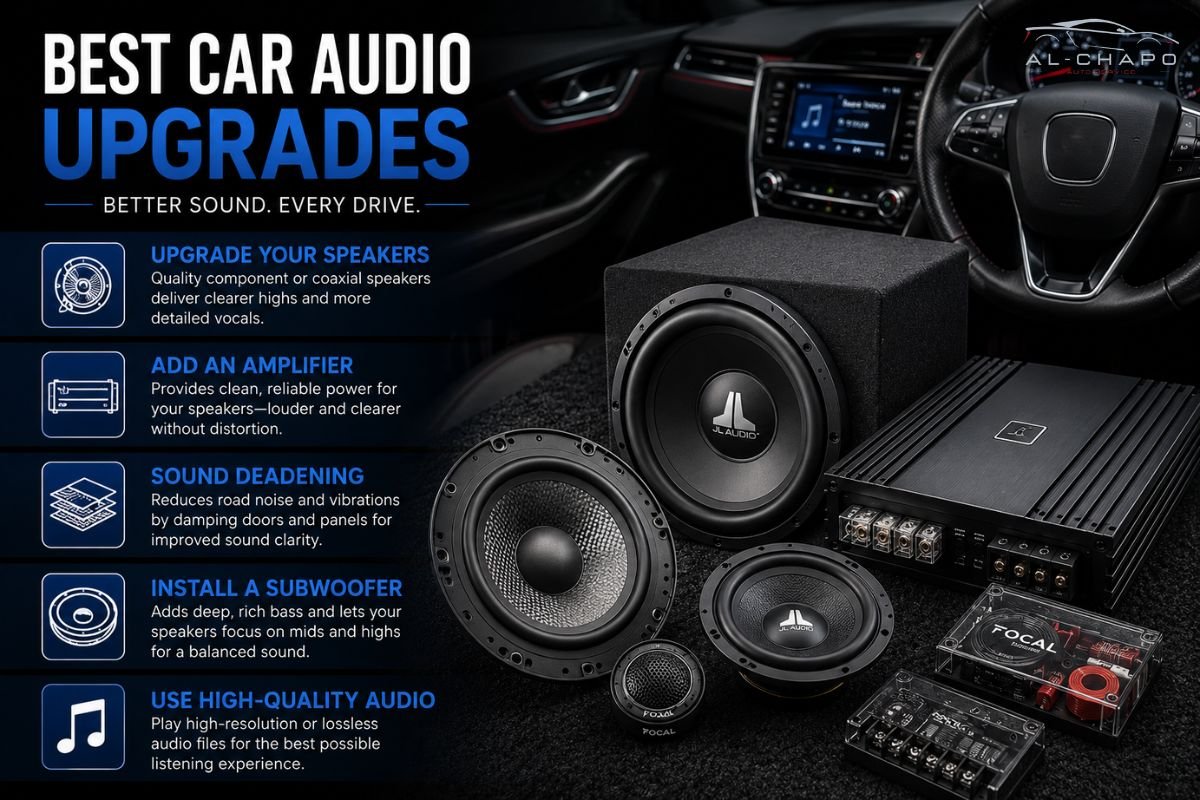
Based on their effect on sound quality, the most effective upgrades for cars include component speakers first because they provide clarity which factory speakers can’t produce; an external amplifier second, providing the proper power to drivers; sound deadening comes third, cutting road noise and vibrations; a subwoofer fourth for the deep bass not produced by regular speakers; and finally high-tech digital processor or new stereo last to optimize sound quality once the rest is done. Speakers provide the best increase in clarity per dirham spent on other upgrades.
- Component speakers — the largest improvement in clarity.
- External amplifier — clean & undistorted power used by those speakers.
- Sound deadening — eliminates rattling noises and road noise.
- Subwoofer — provides the deep sound that cannot be produced by the door speakers.
- DSP or a new head unit — fine-tuning parameters after the rest is set up.
Key Takeaways
- When it comes to value for your money and clarity, installing speakers outweighs any other upgrade you can make.
- In most cases, the issue is not with the speakers but with the low power of the original sound system.
- One of the simplest but effective solutions to improve sound quality is using sound insulation inside door panels.
- The tuning process is very important. It has a crucial influence on the efficiency of the new car audio system.
If your car’s stereo sounds thin or flat even at low volume, the issue usually isn’t the music. It’s the hardware playing it. Factory systems are built to a price point, not a performance target, and speakers, wiring, and amplification all get compromised to hit that number. You don’t need to replace everything to hear a real difference, though. A handful of upgrades, done properly, can change how a cabin sounds. Here’s what actually moves the needle, what’s optional, and where people tend to waste money.
Why do factory sound systems fall short?
Factory speakers are usually thin paper cones with basic magnets. They struggle with bass and distort once you push the volume. The head unit’s built-in amp is often capped around 15-20 watts per channel, nowhere near enough to drive better speakers or a subwoofer. Therefore, door panels are rarely insulated for sound, so vibration and road noise get in the way of anything clean.
However, that’s not bad design, exactly. It’s a system built for cost efficiency across millions of vehicles, not for how it sounds. That’s the whole reason aftermarket upgrades outperform factory tuning so consistently, no matter how many EQ presets the dashboard offers.
Speakers: the upgrade that matters most
If you only touch one thing, make it the speakers. A quality component set, separate tweeters and mid-range woofers with a dedicated crossover, picks up detail that coaxial factory speakers just can’t reproduce. Vocals get clearer. Cymbals stop sounding harsh. You start hearing instruments as separate things instead of one blended wall of sound.
Look for:
- A polypropylene or composite cone rather than paper, which holds up better in heat
- Power handling that matches or slightly exceeds your amplifier’s output
- A crossover that lets you tune the tweeter separately from the woofer
Most shops offering car sound system installation in Dubai will push component sets over coaxial pairs, and for good reason. The price gap is small. The sound gap isn’t.
Adding an amplifier for clean power
Better speakers need clean power to actually sound better. Run them off the factory head unit’s built-in amp, and you’ll usually get clipped, distorted output the moment you turn things up, because that amp was never built for the load. A dedicated external amplifier fixes this by supplying stable power without straining.
However, one mistake I see a lot: buying an amp that’s way more powerful than needed “just in case.” Oversized amps run at low volume can actually sound worse than a properly matched one, since you’re only using a sliver of their power band. Match the amp’s RMS output to what your speakers are rated for. Not the reverse.
Subwoofers and low-frequency balance
A subwoofer isn’t really about volume. It’s about filling in the low end that your door speakers can’t reach. Most speakers, factory or aftermarket, roll off somewhere around 60-80Hz, which is why bass-heavy tracks can sound hollow even on a decent system. One 10- or 12-inch sub in a sealed enclosure, tuned properly, closes that gap without taking over the mix.
Sealed enclosures give tighter, more accurate bass. Ported ones give more output but less precision. For most daily drivers, sealed is the better call, unless you’re specifically chasing competition-level bass.
Sound deadening: the upgrade nobody talks about
This is the step most people skip, and it’s often the one that makes the biggest difference to how everything else sounds. Butyl-based deadening mats inside the door panels and trunk cut down on panel vibration and road noise, which lets your speakers reproduce detail that would otherwise get buried. It also kills rattles at high volume, something a lot of drivers blame on a bad speaker when it’s actually just an unsecured panel.
Doing it properly takes real time. Rush the job, and you lose most of the benefit. This is one place where professional car stereo installation in Dubai genuinely beats a DIY attempt, since even coverage and correct panel prep take experience most first-timers don’t have.
Head units and digital signal processing
Not everyone needs a new head unit. If yours already has clean aux or Bluetooth input, adding a DSP between it and your amplifier can fix timing and frequency issues without replacing anything. A DSP lets a technician time-align each speaker to the driver’s seat, which tightens up imaging more than people expect.
But if your factory unit compresses audio or has weak output voltage, working around it stops making sense at some point. Replacing it with an aftermarket unit that supports high-res audio and proper preamp output is usually the smarter move.
Comparison table: upgrade priority by budget
| Upgrade | Typical Impact | Best For |
| Component speakers | High clarity improvement | Anyone starting an upgrade |
| External amplifier | Clean, distortion-free power | Drivers who listen loud |
| Subwoofer | Fills low-end gap | Bass-heavy music genres |
| Sound deadening | Reduces noise, tightens sound | Daily commuters, older cars |
| DSP / new head unit | Fine-tunes timing and EQ | Fine-tuning an existing setup |
Common mistakes to avoid
A frequent error is putting new speakers into the factory stereo without an amplifier. This can affect your new speakers’ performance.
It is also possible that purchasing a subwoofer without taking the time to verify the proper enclosure size may impact bass performance. The incorrect box will cause the bass to be weak or unbalanced.
Another important consideration is wire size. Thin wires might not be able to carry enough power, resulting in voltage losses and reduced volume.
Finally, proper tuning is crucial. The best components can sound terrible if they are not properly tuned. Good tuning makes every part of the equipment work uniformly and results in a clean and balanced sound.
Wrapping it up
You do not need to replace everything at once to hear a real improvement. Begin with good speakers and adequate power. Add sound deadening if there is noise in your cabin. Use a subwoofer only if your sound requires additional bass. They are all upgrades on top of each other, and sometimes they can be done to save time and money.
If you are in the UAE, then you can get help from Alchapo Auto Service to select and install the appropriate setup. Their team takes care of everything from picking the components to tuning it. They are experts in car audio installation in Dubai and can suggest the audio system based on your car, listening tastes, and budget.
Frequently asked questions
Without any doubt, component speakers. Everything comes after that foundation, and they fix those things that detail factory speakers can’t even do.
In most cases, yes. Factory head units don’t provide “clean” power to good speakers, which is why an amp is necessary to prevent distortion and allow the speakers to perform.
It usually is. It can reduce road noise and panel vibration and many motorists find that a lot of drivers have noticed that improvement before they have handled the first electronic part.
Speaker fitting, amp wiring, deadening (if applying), and the final tuning. The time will vary based on the number of components.
It’s possible but unbalanced! If the door speakers are incapable of keeping pace with bass, the vocals and mids should come first so that the bass doesn’t overpower them.
For daily listening, it’s a win if they’re right and they’re tight. Ported boxes are more about getting output at the expense of precision; they work best in a bass-heavy musical style and are not ideal for everyday use.
Not always. If one is already moved into a clean output, a DSP can correct the timing and EQ without a complete change. Upgrade the unit only if the quality of the output is truly restricted.
The speakers, amp, sub, and deadening typically take a full day to set up at a proper shop, depending on the complexity of the vehicle and number of components.