How Much Does a Car Body Kit Cost? Full Pricing Breakdown & Installation Guide
Table of Contents
- Key takeaways
- What counts as a “body kit”?
- Price breakdown by material
- Price breakdown by car type
- What affects the final bill?
- Car body kit installation: explain the process
- UAE rules you should know before fitting one
- Common mistakes to avoid
- Wrapping up
- Frequently asked questions
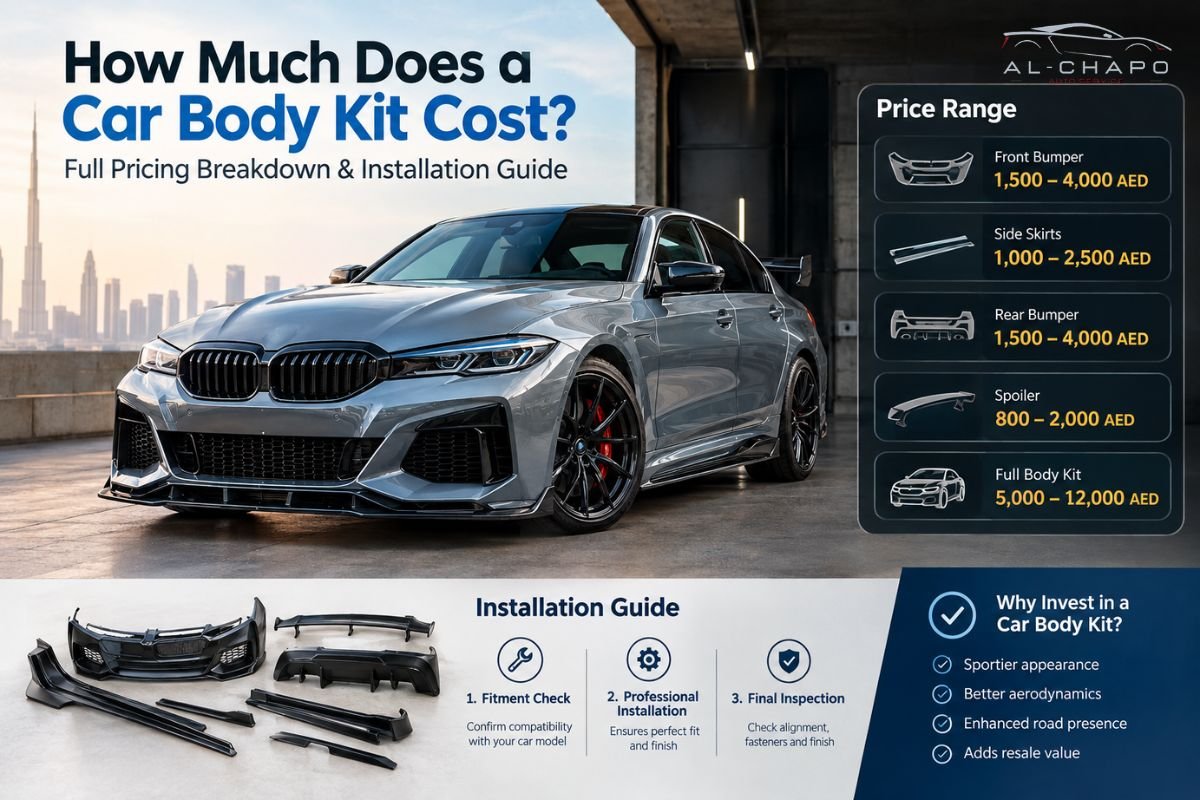
The cost of a basic car body kit in Dubai ranges from AED 1,500 to AED 7,000 if you choose to use either PP or ABS plastic. But when you move to using carbon fiber, the cost is AED 8,000 to AED 20,000, or even higher, depending on several factors involved. Full widebody conversions for luxurious and high-performance cars will cross AED 50,000, excluding the installation service required.
With the addition of 20 to 35 percent for the paint matching and fitting process, the total cost of the body kit will be significantly increased. This was only a rough calculation, but you will learn about the reason for this wide range and where the money will go during the installation.
Key takeaways
- Basic PP and ABS kits will cost you AED 1,500, and it goes to more than AED 50,000 with carbon builds.
- Installation and paint job will add 20 to 35% to the cost of the kit.
- UAE laws restrict the widening of vehicles and require that the lights, sensors, and license plates be visible.
- Hiring an expert for installation will not just improve the aesthetic aspect but also save money while reselling the car.
What counts as a “body kit”?
A body kit does not refer to a single component; it is a set of exterior car body parts that help to transform the look of the vehicle, as well as the airflow around the car in some cases. A full kit usually means a front bumper or lip, skirts, a back bumper or diffuser, and possibly a spoiler or wheel arches as well. Many car owners do not buy full kits and simply restrict themselves to the set of front lip and side skirts, which is a good way to save money.
Material matters more here than most buyers assume going in. Three options cover most of what’s sold in Dubai:
- Fiberglass- costs the least and weighs almost nothing, but it’s brittle. Without proper reinforcement, it can crack in the heat.
- ABS/PP plastic- this is what most daily drivers end up with. It flexes instead of warping through Dubai summers, and the price is reasonable.
- Carbon fiber – it is the toughest and lightest of the three, which is why it shows up mostly on performance and luxury builds, and why it costs the most.
Price breakdown by material
Rough numbers for what each category costs before installation:
| Kit Type | Typical Price Range (AED) | Best Suited For |
| Basic PP/ABS kit | 1,500 – 7,000 | Daily drivers, budget upgrades |
| Premium/Carbon fiber kit | 8,000 – 20,000+ | Sports cars, weight-conscious builds |
| Widebody/luxury conversion | 15,000 – 50,000+ | SUVs like the G-Class, performance cars |
| Small individual parts (lip, skirts only) | 1,500 – 10,000 | Minor styling updates |
Moreover, take these as a starting point, not a ceiling. A no-name kit bought online can come in under the low end, and a widebody program from a known tuning house can go well past AED 50,000 without much effort.
Price breakdown by car type
There are types of cars that get modified frequently in Dubai, and this impacts prices.
- Luxury cars: Widebody modifications can be taken up for prices between AED 15,000 and AED 50,000, depending on the pattern and surface.
- Electric cars: The owners can easily choose changes to front lips, side skirts, and diffusers, usually costing AED 8,000- AED 20,000.
- Supercars: Smaller body kit components can be estimated from AED 10,000, while complete carbon fiber modifications can be priced above AED 30,000.
What affects the final bill?
Two shops quoting the “same” kit can land thousands of dirhams apart. A few reasons come up again and again:
- Material quality. A cheap fiberglass kit from an unknown supplier might not fit right out of the box, and the extra filler and sanding to fix that can end up costing more in labor than a well-made ABS kit would have.
- Paint matching. Getting a factory-accurate color, especially on pearl or metallic finishes, means color-scanning and multiple coats. This is usually the biggest line item after the parts themselves, and it’s the one people underestimate.
- Fitment work. Aftermarket kits rarely bolt on straight. Trimming, aligning gaps, reinforcing mounting points- it all eats labor hours.
- Vehicle type. Curved panels, wider vehicles, and bumpers with embedded sensors or cameras take longer to adapt and cost more.
- Buying versus installing separately. Ordering a kit yourself and bringing it to a different shop can save on parts, but if the kit doesn’t fit cleanly, the labor savings disappear fast.
Car body kit installation: explain the process
Car body kit installation Dubai shops tend to move through the same order every time, and most of the bad outcomes happen when someone skips a step to save time.
- Test fitting- Panels get held against the car before anything is cut or glued, mostly to check gaps against the factory bodywork.
- Trimming and adjustment- Nearly every aftermarket kit needs some trimming, especially around wheel arches and bumper edges.
- Surface preparation- Fiberglass usually needs sanding and primer to smooth the gel coat. PU and ABS parts often need an adhesion promoter before paint will actually stick.
- Mounting- Adhesive, rivets, or factory-style clips, depending on the kit. Tape alone is a common shortcut, and it’s the reason kits shift or peel once the summer heat sets in.
- Paint and blending- New panels get painted and blended into the existing color, ideally with computer color-matching so the shade holds up under different lighting.
- Final fitting and inspection- Panels go back on, gaps get checked one more time, and lights, sensors, and the plate all get confirmed clear.
Therefore, a shop like Alchapo Auto Service, or really any workshop that’s been doing this a while, can usually tell you which of these steps is driving your quote up, since not every car needs all six done in full. A car body kit service built for your exact model needs far less trimming than a universal-fit one.
UAE rules you should know before fitting one
Car body kit services in Dubai are legal here, but there are limits worth knowing before you spend anything:
- Modifications can’t block headlamps, tail lamps, indicators, or the number plate.
- Added width is expected to stay close to the original factory specification per side, not open-ended.
- Exhaust changes that sometimes come with bigger builds fall under federal noise limits.
- Major exterior modifications usually require an inspection afterward, which is a separate small fee from the kit itself.
- It’s worth telling your insurer about exterior changes so coverage doesn’t get complicated later.
None of this is complicated to work around. It mainly means the shop handling your installation of car body kits Dubai, drivers should already know these limits and design around them, rather than you finding out the hard way after the fact.
Common mistakes to avoid
A handful of things go wrong on repeat with body kit projects:
- Picking the cheapest kit without checking the material- A no-name fiberglass kit that looked identical in photos to a branded one can crack within months in the heat.
- Skipping the test fit- Most panel gap complaints trace back to this step getting rushed or skipped entirely.
- Underestimating paint costs- People budget for the kit and forget paint and blending can cost almost as much.
- DIY installs without experience- Between adhesives, heat-shaping, and rivet placement, a first-timer’s install often costs more to redo than it would have cost to do properly from the start.
- Ordering a widebody kit before checking width limits- This should really happen in the opposite order.
Wrapping up
The price gap between a simple ABS front lip and a full widebody carbon fiber conversion can run into tens of thousands of dirhams, and almost all of that gap comes down to three things: the material, how much fitting your specific car needs, and how well the paint matches. Ask any shop for an itemized quote, kit, preparation, paint, and fitting listed separately, before anything gets cut or glued. It’s the one habit that keeps this kind of project from turning into a surprise.
Frequently asked questions
Basic kits start around AED 1,500, carbon fiber mid-range kits run AED 8,000-20,000, and premium widebody conversions can reach AED 50,000 depending on the car and materials.
Rarely. Installation, prep, and paint usually add another 20-35% on top of the kit cost, depending on the material and fitment involved.
ABS/PP plastic holds up well without warping. Fiberglass needs reinforcement to avoid cracking. Carbon fiber holds up best overall but costs more upfront.
You can, but a poor mounting or paint job usually costs more to fix later than professional installation would have cost the first time, especially with adhesive-based kits in the heat.
Insurers should know about exterior modifications so coverage stays valid, since undisclosed changes can complicate a claim down the line.
Usually several days to over a week with paint and blending included, depending on how much trimming and color-matching the job needs.
Yes, within limits. Added width has to stay close to factory spec, and the kit can’t cover lights, sensors, or the plate.
A well-installed kit that matches the car rarely hurts value, and can help on certain models. A poorly fitted or mismatched one usually does the opposite.