
How Does Dubai’s Extreme Heat Affect ECU-Tuned Cars?
Table of Contents
- Key takeaways
- What actually happens to an ECU-tuned engine in Dubai heat?
- Why do tuned cars feel it more than stock cars?
- Signs your tuned car is struggling with heat
- How does ECU remapping adapt to Climate?
- Maintenance that protects a tuned engine in summer
- Common mistakes owners make
- Final thoughts
- Frequently asked questions
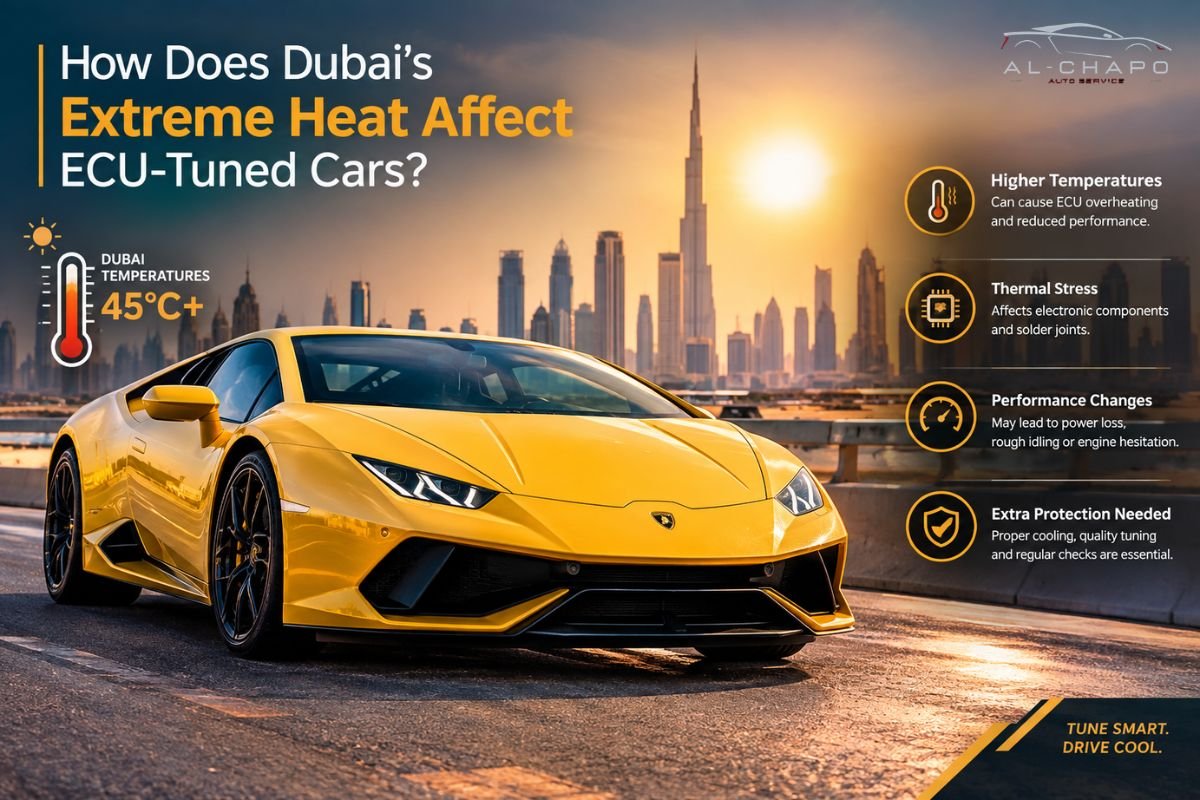
Dubai’s ambient temperature regularly crosses 45°C in summer, and asphalt in direct sun runs hotter still. A stock engine’s ECU has plenty of built-in safety margin for that. A tuned one has less, because higher boost, more advanced timing, and leaner fuelling all put the engine closer to its thermal ceiling before the weather even factors in. Once Dubai heat gets added on top, the ECU starts pulling power back to protect itself, and a lot of drivers never quite figure out why the car suddenly feels flat in traffic.
That’s the quick version. Here’s the rest of it.
Key takeaways
- Heat soak and rising intake air temperature make a tuned ECU retard timing and cut boost. That shows up as lost power, not engine damage, in most cases.
- Aggressive Stage 2 or Stage 3 tunes feel Dubai summer harder than a mild Stage 1 setup, simply because there’s less thermal room to begin with.
- A proper car diagnostic scanner Dubai session catches knock retard, high coolant readings, or a failing sensor before any of it turns into a real repair bill.
- Tunes built around actual UAE climate data hold their power through July and August far better than a generic map ever will.
What actually happens to an ECU-tuned engine in Dubai heat?
Every modern engine leans on sensor feedback. Intake air temperature, coolant temperature, knock sensors, oxygen sensors- all of it feeds the ECU, which adjusts fuelling and timing on the fly. Stock or tuned, that part is the same. What differs is how much breathing room the ECU has been given.
Stock calibrations carry a large safety buffer, mostly because the same base map has to survive an Alaskan winter and a Dubai summer without complaint. A performance tune usually trims that buffer to squeeze out more power, and for most of the year that trade works fine. Then July shows up.
However, as intake air temperature climbs, and in Dubai traffic the air sitting in the engine bay can be well above ambient, the ECU reads that as a detonation risk. So it retards ignition timing, cuts boost on turbocharged cars, and sometimes richens the mixture to cool the combustion chamber down. All of that pulls power out right when the driver’s expecting the tune to earn its keep.
It’s not just aftermarket shops dealing with this either. Ford runs a dedicated summer test program in the UAE desert, watching how powertrain cooling and climate systems hold up past 60°C. That’s roughly the heat load a tuned engine in Dubai is quietly working against on an ordinary commute, not some extreme edge case.
Why do tuned cars feel it more than stock cars?
A handful of things stack on top of each other here:
- Aggressive tunes sit closer to the knock limit to begin with, so there’s less room before the ECU has to step in. More boost and more advanced timing also mean more heat generated per combustion cycle, even before ambient temperature enters the picture. Add aftermarket intakes, exhausts, or intercoolers that weren’t really matched to UAE conditions, and heat builds faster than it clears. And the real stress test isn’t the highway. It’s Sheikh Zayed Road at a crawl in 45°C heat, where the radiator and intercooler barely get any airflow while engine load and the AC compressor stay maxed out.
- A gentle Stage 1 tune usually rides this out fine, since the margins haven’t been pushed hard. Stage 2 and Stage 3 setups are where owners actually notice it, real power loss on the hottest afternoons of the year. Even at the high-performance end, this shows up: dyno work on UAE-spec performance cars now routinely factors in thermal stability and oil-temperature protection, because power that vanishes the moment the engine gets hot isn’t worth much to anyone.
Signs your tuned car is struggling with heat
Some of this is obvious. Some of it creeps in slowly enough that owners just chalk it up to “how the car is in summer” and move on, when it’s actually something fixable.
Worth watching for:
- Noticeably less punch above 3,000 RPM once the engine’s fully warm
- A boost gauge reading lower than usual on hot afternoons
- A slight hesitation under hard acceleration in stop-start traffic
- Cooling fans running almost nonstop, even sitting at idle
- Fuel economy dropping right alongside the power
Furthermore, none of this necessarily means damage. Most of the time, the ECU is doing exactly what it was designed to do, trading power for safety. Still worth looking into rather than ignoring, since months of repeated heat soaking can wear down parts that weren’t really built for that kind of stress.
How does ECU remapping adapt to Climate?
This is really where the quality of the original tune shows. A map pulled from a European or North American database is calibrated for a completely different baseline. ECU remapping services in Dubai that actually understand the local driving reality build their maps around UAE ambient temperatures, local fuel, and the mix of stop-start city traffic and long highway stretches drivers actually deal with here.
In practice, that looks like
- Timing maps with realistic knock-retard thresholds for a normal 40°C-plus day rather than cool test-bench numbers
- Boost targets that taper off as intake temperature rises instead of holding peak boost until the engine has to force a shutdown,
- Cooling-related settings like fan trigger points recalibrated for the modified engine rather than left on stock thresholds.
Alchapo Auto Service builds this climate factor into the tuning process from the start rather than treating it as an afterthought, which is a big part of why a properly calibrated local remap tends to hold its advertised numbers through summer better than an off-the-shelf file does.
Therefore, it’s also worth running a car diagnostic scanner Dubai workshops use both before and after the tune. Beforehand, it establishes a baseline and catches any existing fault that the new calibration might otherwise mask. Afterward, it confirms the ECU isn’t quietly logging knock events or running hotter than it should under real driving, not just on a dyno.
Maintenance that protects a tuned engine in summer
Tuning changes what the engine asks of its supporting systems, so maintenance schedules built for a stock setup sometimes need tightening.
| Component | Why it matters more on a tuned car | Suggested Dubai-summer interval |
| Coolant | Higher combustion temps need coolant actually doing its job | Check monthly, flush per manufacturer schedule |
| Engine oil | Extra thermal load breaks oil down faster | Shorten the interval, ideally with a high-heat-rated synthetic |
| Intercooler/ radiator | Sand and dust choke airflow over time | Clean externally every few months |
| Spark plugs | Wrong heat range wears faster under a tuned load | Confirm heat range matches the tune, not the factory spec |
| Battery | Heat shortens battery life faster on a modified electrical setup | Test before peak summer, not after it fails |
A car engine tuning service Dubai shops offer should really include a conversation about these follow-on maintenance changes, not just hand over the remap and call it done. Skipping that conversation is one of the more common reasons a tune that felt great in April feels disappointing by August.
Common mistakes owners make
A few patterns keep showing up.
- Skipping the diagnostic scan before a remap means any hidden sensor fault just gets baked into the new tune’s assumptions.
- Downloading a generic tune file with no UAE calibration usually performs worse in real Dubai conditions than a locally built one, even when the peak dyno numbers look similar on paper.
- Ignoring an intercooler upgrade on an aggressive tune means the car can’t actually use its extra boost safely once summer hits.
- Putting off oil changes because “the car still feels fine” doesn’t work either, since feel isn’t a reliable gauge of oil condition under sustained heat.
Moreover, then there’s the piecemeal upgrade problem. Owners get car modification services in Dubai done in stages, a cold air intake this month, a cat-back exhaust a few months later, and never go back to have the ECU map adjusted for the combined change. It usually still runs. It just rarely runs as well as it could.
Final thoughts
Heat doesn’t wreck a tuned engine overnight, but it exposes any shortcuts taken during the tune fairly quickly. A remap built around Dubai’s actual driving conditions, backed by real diagnostics and a maintenance schedule adjusted for the extra thermal load, holds up through August a lot better than a generic file chasing the biggest number on a dyno sheet. If the car’s been feeling flat once the temperature climbs, it’s worth getting checked rather than just writing it off as normal for the season.
Frequently asked questions
Rarely on its own. The ECU protects itself through timing and boost cuts. Repeated extreme heat soak without cooling upgrades can wear related parts down faster over time, though.
Less than a Stage 2 or 3 setup would. Stage 1 maps generally keep more thermal safety margin in the calibration.
Every few months at minimum, and right away if you notice reduced power, a rough idle, or a warning light, especially in peak summer.
You can, but generic files rarely account for UAE ambient conditions, local fuel, or your car’s specific hardware, so the risk goes up.
Often, yes, especially on a turbocharged tuned car sitting in stop-start traffic where the stock intercooler barely gets any airflow.
At idle, fairly normal. Constant fan operation while actually driving at speed is worth checking out.