
Why Preventive Maintenance Is Better Than Emergency Repairs
Table of Contents
- Key Takeaways
- What does preventive maintenance actually mean?
- The real cost difference between prevention and emergencies
- How regular servicing protects your engine and battery?
- Common mistakes car owners make in Dubai’s climate
- What a proper maintenance schedule looks like?
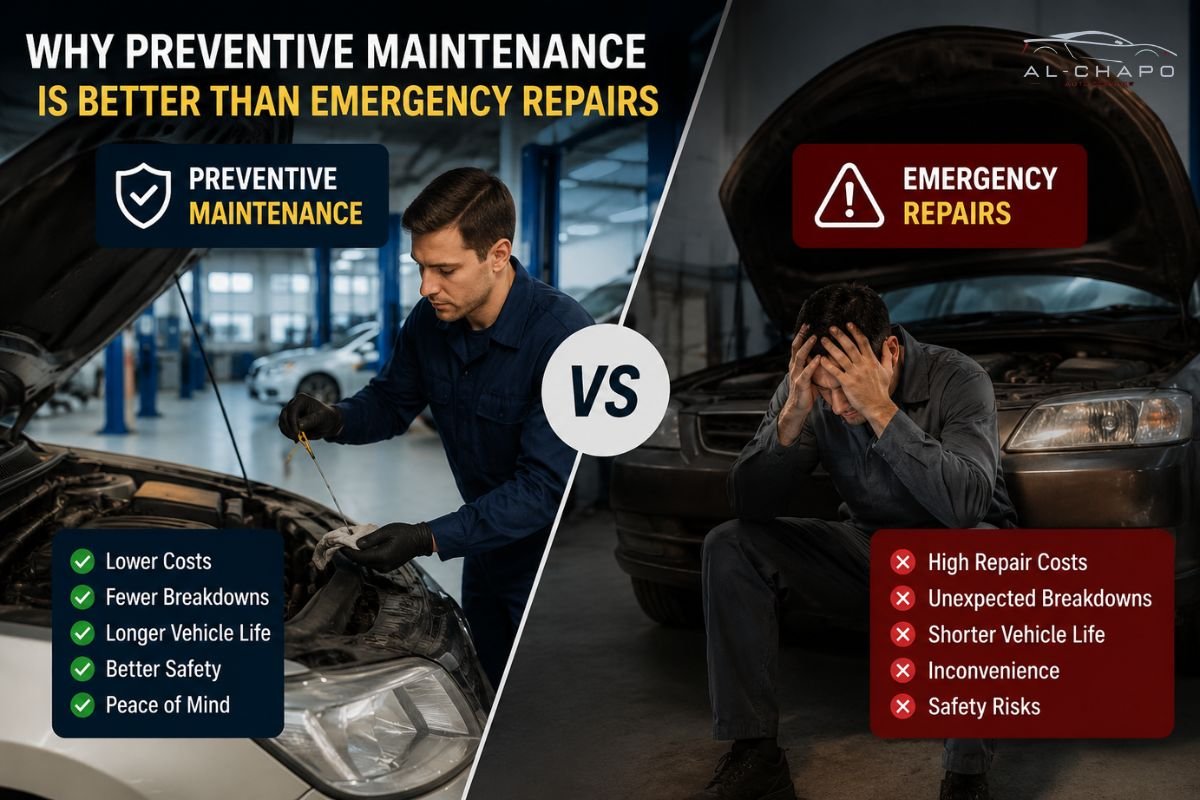
- Preventive maintenance vs emergency repairs: A quick comparison
- Expert insights from the workshop floor
- Wrapping it up
- Frequently asked questions
Key Takeaways
- Preventative maintenance gets to minor problems before they turn into expensive failures.
- The harsh climate in Dubai has an impact on battery, cooling, and tyre performance, meaning regular service is more important than in temperate areas.
- Emergency repairs are always more expensive both in financial and time terms.
- Documenting service history is an asset when selling the vehicle.
Most people don’t think about their car until something goes wrong. The AC stops cooling in the middle of a 45°C afternoon. The battery dies in a mall parking lot on a Thursday evening. At that point you’re not really choosing a repair, you’re stuck with whatever gets you moving again, usually at a worse price and a worse time.
Preventive maintenance is the opposite of that. You catch the small stuff before it becomes the big stuff: a belt that’s starting to fray, a battery that’s losing charge faster than it should, brake pads getting thin. It’s not just more convenient. It changes what you spend over the life of the car, how safe it is to drive day to day, and how long the expensive parts actually last.
This blog is about why scheduled care beats crisis repairs, what that looks like in practice, and how to build a routine that actually fits Dubai’s driving conditions.
What does preventive maintenance actually mean?
Preventive maintenance is inspections, fluid changes, and part swaps done on a schedule, not in response to a problem. Oil changes every 8,000 to 10,000 km. Brake checks at every visit. Coolant flushed before the worst of summer hits. None of it fixes something that’s already broken. It’s meant to stop that from happening in the first place.
However, a repair is different. It’s a response to a symptom the driver already noticed: a noise, a warning light, a smell that wasn’t there last week. Shops offering car repair and maintenance service in Dubai usually do both, but the two are worth keeping separate in your head. Maintenance is planned. Repair is reactive, and often urgent.
People get this confused a lot. If the car “feels fine,” it’s easy to assume maintenance can wait. But a lot of failures give almost no warning. A worn timing belt. Brake fluid that’s quietly degrading. Corroded battery terminals. None of these announce themselves until they fail.
The real cost difference between prevention and emergencies
The math here isn’t complicated. A scheduled oil and filter change costs a small fraction of what an engine rebuild costs after months of running on degraded oil. A brake pad swap is cheap. A warped rotor from ignoring worn pads for too long is not.
Furthermore, emergency repairs also drag in costs that scheduled maintenance never touches. Towing, if the car dies somewhere inconvenient. Rush labor rates at whatever shop can squeeze you in same-day. And secondary damage, which is the expensive one: a failed water pump can overheat the engine and warp a cylinder head if the car’s driven even a short distance after the warning light comes on.
This isn’t a hypothetical. It’s a pattern we see over and over at the workshop. Someone skips a coolant check, and six months later they’re paying for head gasket work that costs ten times what the original inspection would have.
How regular servicing protects your engine and battery?
Dubai’s climate is genuinely rougher on a car than most places. Sustained heat above 40°C breaks down oil faster, stresses rubber hoses and belts, and cuts battery lifespan noticeably compared to cooler regions.
Batteries take the worst of it. Heat speeds up the chemical reaction inside a lead-acid battery, which sounds like it should be a good thing. It isn’t. It accelerates corrosion inside the battery and evaporates the fluid faster, which shortens how long the battery actually lasts. That’s why car battery maintenance services in Dubai usually include testing battery health at every visit instead of waiting for a no-start morning. A battery that tests weak in March can be dead by July.
Additionally, cooling systems face something similar. Coolant that’s overdue for a flush stops protecting against corrosion and loses some of its ability to manage heat, right when the outside temperature is already working against the engine. Checking it twice a year instead of once makes a real difference here, more than it would somewhere with a milder climate.
Common mistakes car owners make in Dubai’s climate
A few things come up constantly.
- Drivers ignore the AC until it fails. A slow refrigerant leak is cheap to fix early. Once the compressor seizes from running low, it isn’t.
- They skip battery testing because the car still starts fine. A battery can lose 30 to 40 percent of its capacity and still crank the engine, right up until a particularly hot afternoon pushes it past what’s left.
- Tyre rotation and pressure checks get pushed back too. Hot asphalt wears tires faster than people expect, and underinflated tires in that kind of heat raise the odds of a blowout on something like Sheikh Zayed Road.
- Therefore, there’s a common misread on synthetic oil. It does last longer than conventional oil, but people assume that means the interval doesn’t need adjusting for Dubai’s heat. It does, even with synthetic.
None of this is really about negligence. It’s that most people don’t realize how much the local climate shifts the math on wear.
What a proper maintenance schedule looks like?
A dependable routine for car routine maintenance services in Dubai generally looks something like this:
| Service | Recommended Interval |
|---|---|
| Engine oil and filter change | Every 8,000–10,000 km |
| Battery health test | Every visit, more often once the battery is over 2 years old |
| Coolant system check | Every 6 months |
| Brake inspection | Every visit |
| AC performance check | Before summer, or every 6 months |
| Tyre rotation and pressure check | Every 10,000 km |
| Air and cabin filter replacement | Every 15,000–20,000 km |
There are many factors that can affect the maintenance requirements for a car such as the age of a car, mileage and driving preferences. Cars that are driven in cities with heavy traffic may require a different maintenance approach compared to cars driven on highways. A reputed service provider will customize the maintenance schedule for a car according to its actual requirements.
Preventive maintenance vs emergency repairs: A quick comparison
| Factor | Preventive Maintenance | Emergency Repair |
|---|---|---|
| Cost | Lower, predictable | Higher, often at rush rates |
| Timing | You choose when | Never when you want it |
| Safety risk | Low, caught early | Higher, can fail mid-drive |
| Resale value | Helps it | Hurts it |
| Parts affected | Usually just one | Often several, from secondary damage |
Expert insights from the workshop floor
After years of handling both scheduled visits and emergency call-ins, one thing stands out clearly: the customers who stick to a maintenance calendar rarely turn up with a dead battery on the roadside. The ones who don’t, do, pretty much every summer without fail.
There’s a resale angle a lot of people miss too. A car with a documented maintenance file, the kind of car repairs services Dubai buyers can actually check against invoices, tends to sell faster and for more than one with no paper trail. Dealers especially treat that history as a stand-in for how the car was actually looked after.
Worth saying plainly: preventive maintenance isn’t about replacing parts that still have life in them. It’s testing and inspecting on schedule, then replacing only what the inspection actually shows needs it. Over-servicing wastes money the same way under-servicing does. The point is accuracy, not just doing things often.
Wrapping it up
Many emergency repairs begin because of a missed inspection or a neglected warning light. Regular maintenance can save you repair expenses, enhance road safety and maintain the value of your car.
If it’s been a few months since your last service or you don’t recall the last time to check the battery or coolant levels, you might need to have them checked. Alchapo Auto Service’s full inspection and maintenance services are tailored for Dubai’s warm weather and driving environment.
Frequently asked questions
Oil change 8,000 – 10,000 km, battery and coolant tested at every service. Here, the heat shortens what is safe and the lower end is the safer bet compared to cooler climates.
In nearly all instances, yes. Scheduling a replacement of a part is much less expensive than failing and bringing other parts with it.
During the service visit, a load test will indicate when the car is losing capacity before it actually won’t start. After the second year, it’s important to test a battery at each appointment, particularly before the summer months.
Ignoring initial warning signs, slower cooling times and slower cold-start cranking in favor of letting the AC and battery go dead.
Yes. A documented history can put buyers at ease and it will improve sale rates and the value of a car with a documented history.
Twice-yearly instead of once-yearly recommendations. Most manufacturer-recommended settings underestimate the amount of stress that a sustained heat puts on the cooling system.
Not really. There are lots of times that belts are broken, brake fluid is worn out and nothing can be done about it until disaster strikes.
Routine oil & filter changes, brake inspections, battery testing, coolant testing, AC performance tests and tyre rotation – adapted to your driving schedule, not a one-size schedule.
Not by much. It lasts longer than regular oil but the Dubai heat will still shorten the practical interval below the recommended for less hot climates.
Get one that gives you an actual inspection report, not just a stamp in a service book, and one that will accomodate your schedule for your car, rather than using the same interval for everyone.