
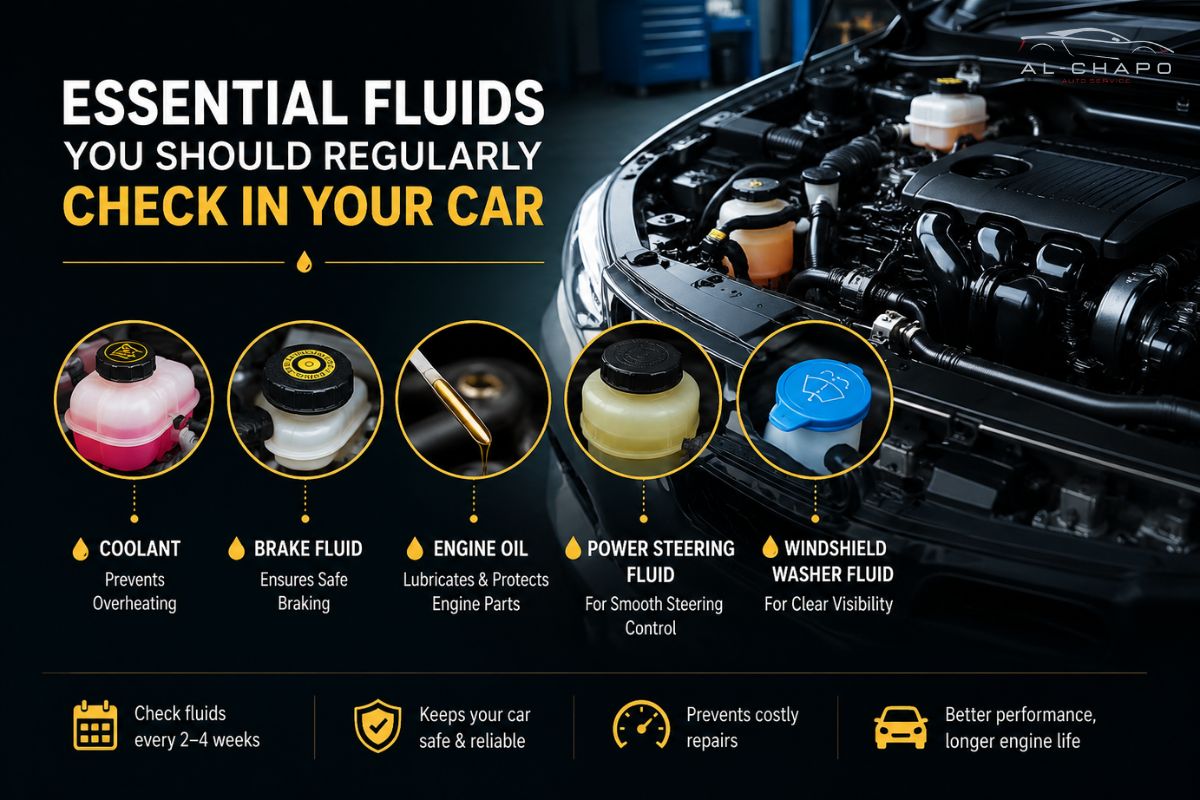
Essential Fluids You Should Regularly Check in Your Car
Table of Contents
- Key takeaways
- Why fluid checks matter more in Dubai’s climate?
- Engine oil: The one everyone knows (but still gets wrong)
- Coolant: your engine’s defense against the heat
- Brake fluid: small reservoir, big responsibility
- Transmission fluid: often ignored, rarely forgiven
- Power steering fluid and windshield washer fluid
- A quick comparison of check intervals
- Common mistakes drivers make
- Expert recommendation
- Final thoughts
- Frequently asked questions
Key Takeaways
- Six essential fluids require regular servicing: oil, antifreeze, brake fluid, gearbox oil, power steering fluid, and cleaning fluid.
- Because of the extremely hot weather in Dubai, the intervals applicable to cooler climates don’t work here.
- In most cases, the presence of low or discolored fluid means that there is a leak somewhere in the system or one of the parts needs replacement.
- In Dubai, scheduling routine car repairs every three to six months ensures that the majority of problems with car fluids are experienced in time and taken care of before serious damage is done.
Your car is operated by more than just fuel. Six fluids are constantly at work behind the scenes. Six fluids serve to cool the engine, ensure brakes work properly, and are responsible for the proper operation of the steering wheel. If they are neglected, the repair is very likely to cost more than just five minutes of inspection. Here’s the information regarding these fluids, the frequency of their servicing, and the signs indicating their troubles.
Why fluid checks matter more in Dubai’s climate?
Summer temperatures here sit above 45°C for weeks at a time, and that kind of heat doesn’t just make the cabin unbearable. It stresses every fluid under the hood. Oil breaks down faster. Coolant works overtime just to keep pace. Rubber seals dry out and start leaking well before the schedule in a manual written for a temperate country would suggest.
However, that’s the problem with copying a maintenance routine off a UK or US car forum. It’s not that the cars are built differently. It’s that the environment here works them harder, so the intervals need to shrink.
At Alchapo Auto Service, we consistently witness a recurring pattern with a car that has spent its entire life traveling short distances in fuss Deira or Al Quoz traffic and then left to bake under the sun for hours before embarking on a long journey in the heat to Abu Dhabi.
Engine oil: The one everyone knows (but still gets wrong)
Everyone knows oil needs changing eventually. Fewer people actually check it between changes, or know what the color and texture are telling them.
How to check it properly:
- Park on level ground and give the engine a few minutes to settle.
- Pull the dipstick, wipe it clean, then reinsert it fully before pulling it out again for the real reading.
- The level should sit between the two markers. Below the minimum means it’s time to top up.
- Fresh oil looks amber and see-through. Dark, gritty, or sludgy oil means it’s overdue.
Therefore, conventional oil generally needs changing every 5,000 to 7,500 km, while synthetic can stretch to 10,000–15,000 km. Given Dubai’s heat and traffic, it’s worth checking the level monthly instead of waiting for the scheduled service, particularly on an older or higher-mileage car.
A car oil change service Dubai drivers trust will also check the oil filter at the same visit, which is easy to miss if you’re only topping up fluid yourself.
Coolant: your engine’s defense against the heat
The coolant, which is also known as antifreeze, prevents the engine from overheating and prevents internal corrosion of the coolant radiator. In this climate, coolant checks may be more important than those of other fluids.
A coolant reservoir should only be checked when the engine is completely cold. It should never be opened while it is hot; pressurized coolant can cause burns. The coolant level must be between the marked lines “low” and “full”.
When checking the coolant quality, be alert to:
- The sweet smell in the area of the engine bay. This indicates that there is some minor leak.
- Rusty or muddy coolant or the presence of visible particles in it.
- Increase in temperature on the gauge, especially when there is stop-and-go traffic.
Most types of antifreeze will need to be replaced every couple of years or around 40,000 km. Not monitoring the levels of antifreeze can lead to huge damage to the engine in a hot climate. Just a few minutes of overheating can warp the cylinder head.
Brake fluid: small reservoir, big responsibility
The brake fluid reservoir is a small and quiet part of the vehicle’s engine, but it plays an important role. The pressure that must be created by your foot has to go through this fluid before it gets to the brake pads.
The brake fluid level has to be between the minimum and maximum lines on the container. The color of the fluid has to be clear or pale yellow. When it becomes dark brown, that means the fluid is old.
You should act as fast as possible if:
- You notice that your brake pedal feels more flexible.
- You see a warning light on the dashboard.
- You see leaking fluid near the front wheels of the car.
It should also be mentioned that every car needs a brake fluid change every two years, even if it didn’t travel much during this period.
Transmission fluid: often ignored, rarely forgiven
Transmission fluid tends to go unchecked until there’s already a problem: a hard shift, a hesitation before the gear engages, maybe a whine that wasn’t there before. By that point, the fluid has usually been low or degraded for a while already.
Automatic transmission fluid should be checked with the engine running and warm, following the method specific to your vehicle since it varies by model. It should look red or pink and smell faintly sweet. Brown, burnt-smelling fluid means internal wear has already started.
Some newer vehicles use sealed, “lifetime” transmission fluid that was never meant to be checked with a dipstick. For those, a technician needs to inspect it through the vehicle’s service port, which is one more reason for routine inspection from a car repair and maintenance service in Dubai, you trust beats guesswork at home.
Power steering fluid and windshield washer fluid
These two get skipped because they rarely fail dramatically, but they still matter for comfort and safety.
- Power steering fluid- This fluid can be checked only when the engine is off and cool. A low power steering level can first become noticeable because of stiffer steering or a whistling sound in the steering at lower speeds. Usually, a leak here results from a worn hose or seal; thus, it is crucial to check it before the pump gets damaged.
- Windshield washer fluid- Although it has no impact on the car’s performance, finishing it during a dust storm in Dubai means using dry wipers on your windshield, and that may lead to scratches on the glass.
A quick comparison of check intervals
| Fluid | Check Frequency | Replace Every |
| Engine oil | Monthly | 5,000–15,000 km |
| Coolant | Every 3 months | ~40,000 km / 2 years |
| Brake fluid | Every 6 months | 2 years |
| Transmission fluid | Every 6 months | 60,000–100,000 km |
| Power steering fluid | Every 3 months | As needed / on leak |
| Washer fluid | Monthly | Top up only |
These numbers assume fairly typical Dubai driving: daily commuting, the occasional highway run, and constant exposure to heat. Vehicles used for long-distance or heavy-duty driving may need checks more often than this.
Common mistakes drivers make
- Topping up without asking why. If a fluid keeps dropping, something is leaking or burning it off. Refilling on repeat just postpones the actual repair.
- Mixing fluid types. Coolant and brake fluid formulas aren’t all compatible with each other. Get it wrong, and you risk corrosion or weaker braking.
- Tossing out the manual’s intervals entirely. Manuals are written for average conditions, and Dubai isn’t exactly average, but they’re still a reasonable starting point to adjust from rather than ignore.
- Waiting for the warning light. Most fluid warning lights only trip once the level is critically low, not when it first starts dropping.
Expert recommendation
If tracking six different fluids yourself sounds like more hassle than it’s worth, one scheduled inspection covers all of them in a single visit. Booking car routine maintenance services in Dubai on a set schedule, instead of reacting once something goes wrong, tends to cost noticeably less over the life of the car than emergency repairs do.
Alchapo Auto Service handles full fluid inspections as part of routine visits, checking levels and condition and flagging the leaks that cause repeat top-ups. If you’re not sure where your car currently stands, a general vehicle inspection service in Dubai appointment is a reasonable place to start before committing to any specific repair.
Final thoughts
Fluid checks might be boring, but they are one of the simplest ways to keep from becoming stuck in traffic in Dubai or on a long road. Engine oil, coolant, brake fluid, transmission fluid, power steering fluid, and washer fluid serve different purposes, and any time one of these fluids runs low or becomes contaminated, it can create serious issues for the car.
Taking a few minutes every month to check the fluids, along with a professional inspection periodically, can help catch any trouble before it becomes financially painful. If you have not done it in a while, that is usually all the reason you need to make sure the fluids are checked.
Book your next fluid check and full inspection with Alchapo Auto Service, and head into Dubai’s roads and heat knowing your car is actually ready for them.
Frequently asked questions
Check it monthly, or before any long drive. Dubai’s heat and stop-and-go traffic wear oil down faster than in cooler climates, so a monthly check catches problems early.
Amber and see-through. Dark, gritty, or sludgy oil is overdue for a change, worth bringing up at your next car oil change service Dubai visit.
Indeed. When there is low coolant, it can lead to overheating, and overheating can easily lead to warping of the cylinder head or damaging the engine block in a matter of minutes, especially during hot summer months such as in Dubai.
If it has gone from a clear or light amber color to a dark brown color or the pedal has been feeling softer lately, then it might be time to ditch it and flush it out, since the moisture it has absorbed reduces the braking power of the brakes over time.
No, it isn’t. Transmission fluid lubricates the parts of the gear train while engine oil lubricates the various parts of the engine. They serve completely different subsystems and are not interchangeable.
A stiff or noisy steering tends to mean low power steering fluid or leakage in the system. Therefore, it is good to check if there is enough fluid and see if there are leaks before the pump gets damaged.
Getting your vehicle seen by professional vehicle inspection service providers in Dubai once every three to six months seems to be enough for ensuring timely identification of any issues related to your vehicle’s fluid, brakes, and overall performance.
Yes. Due to high temperatures in Dubai, fluids break down faster, thus limiting the lifespan of seals and hoses.