
How to Protect Your Engine After a Stage 1 ECU Tune
Table of Contents
- Key takeaways
- What does a Stage 1 ECU tune actually change?
- Why does engine protection matter after a Stage 1 tune?
- How often should you service a tuned car?
- Choosing the right fuel and engine oil
- Keeping your cooling system under control
- Driving habits that protect your engine
- Warning signs to watch for
- Where to get your tuned car serviced?
- Bottom line
- Frequently asked questions
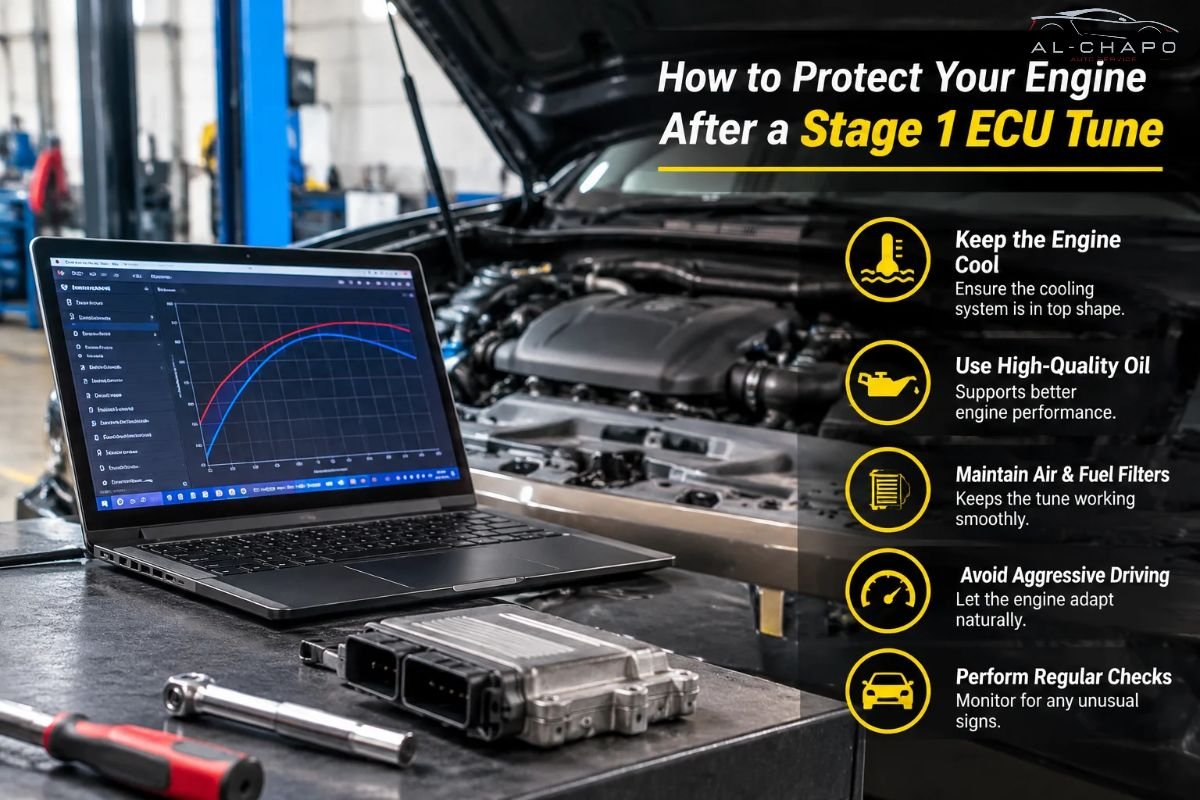
A Stage 1 ECU tune is among the most common methods for enhancing the performance of a vehicle. The procedure involves changing the settings in the engine control unit so that fuel delivery, ignition timing, and boost pressure are tuned in such a way that they produce the maximum power and torque without using any new parts. However, additional performance has a negative effect on the engine as well, increasing pressure in the system. The following blog explains how to keep the engine in its best condition after a Stage 1 ECU tune, covering oil, fuel, relying on proper cooling, regular maintenance of the car, and driving used on a day-to-day basis.
Key takeaways
- Shorter oil change intervals and quality synthetic oils help to prevent overheating of engines due to excessive use or wear.
- Octane rating and fuel grade recommendations for tuning prevent knock while maintaining performance consistency.
- A healthy cooling system, with fresh coolant and working fans, is important to ensure longevity of a machine.
- Early warning signals like knocking, smoke, or boost loss must be checked immediately rather than being ignored.
What does a Stage 1 ECU tune actually change?
Your engine control unit (ECU) is the computer that controls how your engine takes in air, burns fuel, and times the sparks. There’s a rewrite of part of that software called a Stage 1 tune. It typically increases boost pressure, feeds the ignition timing forward slightly, and makes the throttle response more crisp on turbocharged engines. Many people view Stage 1 as a sensible initial upgrade, as it will leave the factory equipment unchanged.
Since it is a software change, the quality of the work will be dependent on the person making the calibration. When searching for a car engine tuning service in Dubai, it is important to find a team that measures performance, rather than making educated guesses. A careful tuner does test air-fuel ratios, knock activity, and temperatures throughout the entire operating range before declaring the job done.
How does Stage 1 remapping work?
The tuner’s startup begins with reading in the original map from your ECU and saving a backup. The map consists of tables that are used to regulate the duration of fuel injection, the boost targets, and the ignition timing for various combinations of engine speed and load. The tuner then tweaks the parameters within zones where the engine can safely create greater power.
Good calibration isn’t just about increasing the numbers at full throttle. It also maintains the mixture within safe limits during partial load, cruising, and cold starts, when most engines are most vulnerable. One of the most frequent remapping pitfalls in low-cost remapping is to overlook these areas- and then have issues months later.
Typical power and torque gains
Proceed with caution, as gains are dependent on the engine design, turbocharger, and fuel quality and level of the car. The approximate ranges for common petrol engines are shown below. Numbers are intended as a guide only and may not be the same across platforms.
| Engine Type | Typical Power Gain | Typical Torque Gain | Main Changes Involved |
| 1.5L to 2.0L turbo petrol | 15% to 25% | 20% to 30% | Boost, timing, fuel |
| 2.5L to 3.0L turbo petrol | 10% to 20% | 15% to 25% | Boost, timing |
| Naturally aspirated petrol | 3% to 7% | 3% to 6% | Timing, throttle response |
Naturally aspirated engines see fewer improvements, due to no boost to be increased. Many owners opt to go with a different upgrade route for their music, mainly because of the throttle response and timing aspects of their song.
Why does engine protection matter after a Stage 1 tune?
The more power, the more heat, the more cylinder pressure, and the more mechanical load. Components that were not stressed by the factory production may now be stressed. Maintenance of those safety margins is key to protecting your engine, allowing the car to support the increased strain each day without premature wear.
Owners of engines in Dubai have to deal with more problems. The ambient temperature in summer regularly rises above 45°C, and frequent stop-start driving leaves the engine bay warm for extended periods of time. They cause this cooling system to have to run harder, and are a safety factor drain on a tuned machine. Hence, taking climatic considerations into account is an essential ingredient of any protection plan.
The first step to ensure safety is to choose a credible provider of ECU remapping services in Dubai. A good service will perform a pre-tuning checkup, register the original data, and explain the changes made in the mapping process. This information greatly facilitates identifying potential problems and checking if the tune has done its job.
- Extra Stress on Internal Components
The pistons, connecting rods, bearings, and turbocharger all operate at higher pressures and spins post-tune. As time passes, a worn bearing, worn piston rings, or an old valve spring all become bigger problems. The condition of the engine before tuning is a critical factor, as a tune will make any problems that the engine has louder.
The song can’t fix a neglected engine, though. A pre-tune inspection should also check for compression readings, oil leaks, boost leaks, spark plugs, and ignition coils. The engine should be fixed up before the tune, not after, if there are any faults present.
- Boost, Heat and Knock
The more boost, the more the air temperature into the engine will be increased. Hot air is less dense, and hot air can also contribute to the possibility of knock, a destructive detonation from fuel igniting unevenly. Consequently, the ECU retrieves the timing to save the engine, and that might mean that you’re seeing a loss of gains you paid for.
The temperatures are held in check by intercoolers, clean air filters, and unrestricted intake piping. A good tune also takes these things into consideration and will target boost and timing levels that will be applicable in the real world that the car will be used in, not just on a dyno.
How often should you service a tuned car?
Tuned engines require more care than stock engines. As heat, pressure and load all increase, fluids decompose more rapidly, and small faults become more expensive. Some oil change specialists suggest that the frequency be reduced and set at 5,000 to 7,000 kilometres, depending on driving conditions and climate.
A steady service plan maintains predictable and small problems. Car routine maintenance services in Dubai can be performed regularly, so that it becomes easy to monitor the state of fluids, detect leaks early, and change the worn parts before they malfunction. A logbook is important to keep track of every service performed and will also help when selling the car; buyers or tuners can see how the car’s been treated.
Oil Change Intervals
High heat and extended load increase the rate of loss of oil protective film. When the film is compromised, the contact between metal parts, like in bearings, the camshaft, and the turbocharger shaft, becomes greater. Changing the oil more frequently removes contaminants, restores lubrication, and keeps those components running cooler.
Select a good oil filter, too. A low-cost filter can allow particles to pass or cause it to back up, making frequent oil changes ineffective. Replace the filter at each service along with the oil, as per the manufacturer’s recommendations.
Air, Fuel and Spark Plug Checks
The performance of the tune is influenced by air filters, fuel filters, and spark plugs. When the air filter is clogged, the engine is deprived of oxygen, and this may lead the ECU to run the engine richer than required. A clogged fuel filter can result in lean conditions under load, leading to higher temperatures. Over time, a damaged catalytic converter can be caused by a misfire due to worn spark plugs under boost.
These parts are kept in good condition with a simple checklist at each service:
- The air filter needs to be checked and put in a replacement if it has accumulated excessive dirt and oil.
- The fuel filter must be compared against the replacement schedule by the manufacturer.
- The condition of the spark plugs has to be determined, and carbon buildup and gaps checked.
- Check for malfunctioning ignition coils and inspect all their wires.
- Inspect the piping used for the intake and the behaviour of the boosting hose, including the points at which it is connected.
Choosing the right fuel and engine oil
Fuel quality in the fuel tank and oil quality in the oil sump directly affect the safe operation of a tuned engine. Knock is a potential problem with lower-quality fuel, and the wrong oil will get cooked at higher boost. Either option is straightforward to achieve and provides a significant influence on long-term reliability.
Why fuel octane matters?
The basic stage 1 maps are typically designed to be used on a one-octane fuel. The ECU may retard the ignition timing to prevent knock if the grade is lower than the tune expects. It surely shields the engine, but also takes some power you’ve paid for and may cause your car to feel underpowered.
Use the same octane specified by the tuner and do not use fuel that has been supplied by a different company. If you ever experience pinging or a decrease in performance after refuelling, test at another station before deciding the tune has a fault. It’s also important to note the brand of fuel used in case a problem develops later.
Selecting the correct oil
Search for the completely synthetic oil that adheres to the manufacturer’s specification. Synthetic oils also have improved resistance to thermal decomposition compared to mineral oil, which is important in turbocharged engines. Viscosity is also significant as hot Dubai conditions may cause oil to become too thin and lose film strength if the grade is incorrect.
The table below summarises the key factors to consider when selecting oil for a tuned engine.
| Oil Factor | What to Look For | Why It Matters |
| Base oil | Fully synthetic | Better resistance to heat breakdown |
| Viscosity | Grade approved by the manufacturer | Correct film strength at operating temperature |
| Specification | Meets the manufacturer’s standard | Protects turbo bearings and timing components |
| Change interval | Every 5,000 to 7,000 km for tuned cars | Limits sludge build-up and wear |
Keeping your cooling system under control
The top concern for any tuned engine is heat. The additional heat generated from the increase in boost and richness of the fuel needs to be removed from the system in traffic, on the highways, and throughout the hottest part of the day. If there’s not enough coolant, a faulty radiator, or a failing fan, a good tune can turn into an expensive repair in no time.
Cooling issues tend to build up over time. Coolant is depleted of corrosion inhibitors, debris accumulates in the radiator fins, and fan motors deteriorate with age. All of these changes diminish the margin of safety, and frequent inspection is of greater importance on a tuned car than on a stock car.
- Radiator, Coolant and Fans
Monitor and maintain coolant level and condition on all services. As the coolant ages, it will no longer provide any corrosion protection, potentially causing scale in the radiator and obstruction in the water passages. Always follow the manufacturer’s recommendations for the type of coolant to use, and change it according to schedule, not when warned by a light.
Check the radiator for bent fins, debris, and oil contamination. Ensure electric cooling fans start at the appropriate temperature and run at maximum speed as needed. An air conditioning-capable fan, for example, that only operates when the air conditioning is operating could not be adequate if the car is idling in traffic.
- Monitoring Temperatures on Dubai Roads
A gauge or diagnostic application that indicates coolant and intake air temperatures will help detect issues early. Some owners use the dashboard warning light, but it’s not until the temperatures have risen. The engine may have been running for an extended period of time at this point.
Look at trends, not individual readings. If the temperature of the coolant increases slightly more each week, or if the intake remains hot after a short distance, then there is a problem with the cooling or intake system. It is much less expensive to prevent damage in the first place than to fix the damage later.
Driving habits that protect your engine
Driving habits are as important to engine life as the tuning of the car. The stress of hard starts, numerous idles, and heavy throttle on a cold engine can all be avoided by a careful driver. Simple habits can have a big impact, particularly in the first weeks after a tune.
Consider these first few hundred kilometres as a settling-in time. Piston rings, bearings, and turbo seals bed in slowly over time and are helped to do so by gentle driving. After the engine has settled down, and the service history has been determined, you can ease back into driving.
The following steps are a sensible routine during the first weeks after your tune:
- Preheat the engine for 2-3 minutes before taking full advantage of the throttle.
- Don’t start any full load runs until the engine is at a normal operating temperature.
- After the turbo has cooled down, run the engine for about 30 seconds before turning it off.
- Maintain moderate to gentle running for the first couple hundred kilometres, letting components settle.
- If there are any changes in noise, smell, vibration, or temperature, notify your tuner.
Don’t launch aggressively or hard accelerate from low speeds, particularly in warm weather. Those activities cause instant bursts of boost, load, and heat. Fluid, gradual throttle inputs allow the engine to adjust and minimize the risk of knock.
Warning signs to watch for
If early signs of trouble are detected, an engine can avoid serious damage. A lot of issues will speak up before they get serious, but drivers will just ignore them because they don’t feel any different. Practical protection of your investment is achieved by learning what to look for.
Watch for these common signs after a tune:
- Knocking or pinging under acceleration, which can signal a lean mixture, low-octane fuel, or carbon build-up.
- If exhaust smoke is blue, white, or black, it is indicative of oil burning, coolant leaks, or rich running.
- Increased pressure that decreases, is late, or changes, commonly due to intake piping leaks.
- The check engine light or loss of power, possibly due to the ECU going into protective mode.
- Low levels between services, indicating leaks or internal wear.
If you see any of these symptoms, ease up on hard driving and get an inspection done as soon as possible. An engine rebuild is much more expensive than early action. Drivers trust the best car service center Dubai to be at the workshop with the best chance of a swift and accurate diagnosis as soon as they encounter a problem.
Where to get your tuned car serviced?
The selection of an appropriate workshop is just as important as selecting a good song. An expert team knows about the impact of calibration on all aspects of a vehicle, such as fueling and ignition systems, engine cooling systems, and lubricating oil pumps. This information helps them identify issues that may be overlooked by an ordinary workshop due to a lack of expertise.
Ask some practical questions about them when choosing an option to book. Check if this company is familiar with your vehicle model, whether it logs information prior to and after tuning sessions, and what components they repair. Good communication regarding warranty information, maintenance services, and post-sale support is an indicator of good business practices.
What to look for in a workshop?
The reliability of a workshop is to explain how the tune changes and why. Baseline measurement would be provided for this purpose; it is also an opportunity to talk about possible improvements realistically while recommending an appropriate service plan accordingly. If someone promises very large gains from a simple software change, beware of such claims.
Transparency of price and quality is important to me. Good workshops should show you what needs to be replaced, why it is necessary for replacement, and provide documentation that can be reviewed later on. These habits help to establish trust while making it much simpler for people to own something over time.
At Alchapo Auto Service, they believe that an automobile needs maintenance throughout its life cycle, starting from when it is first driven till then next oil change. Careful calibration is combined with regular testing to ensure that customers get better results from their investments without any worry about it.
Why does local expertise help?
The weather, roads, and petrol availability are different to those of most other countries. Technicians at local shops are aware of these issues on a daily basis and what affects them when tuning vehicles. They know about heat buildup from cars, dust affecting air filter lifespan, and cooling system deterioration due to high temperature exposure.
If you are looking for an excellent car service center in Dubai as a driver, then there is no better place than to go to a local workshop that knows about this area. Local knowledge is useful for providing specific, practical tips to drivers’ needs.
Bottom line
Stage 1 tune is an upgrading option that can be used effectively within an overall health program. Oil change, coolant replacement, driving habits, and workshop selection all contribute towards maintaining your vehicle’s performance after purchase.
Get an ECU remap service from a reliable company based out of Dubai to keep up to date with maintenance needs so that your tuned engine will run well for many years. Go to Alchapo Auto Service to schedule an appointment.
Frequently asked questions
An appropriately calibrated Stage 1 tuning service provided by a reputable ECU remapping company in Dubai can be used safely for regular driving if it is done correctly.
Oil changes for most tuned cars are required at intervals of 5,000-7,000 km, along with regular checkups by an auto service center in Dubai.
The warranty terms differ from brand to brand; therefore, you should check out their policies beforehand. Service records and approved parts are helpful.
Turbocharged petrol cars tend to have higher gains than other engines by about 15-25%.