
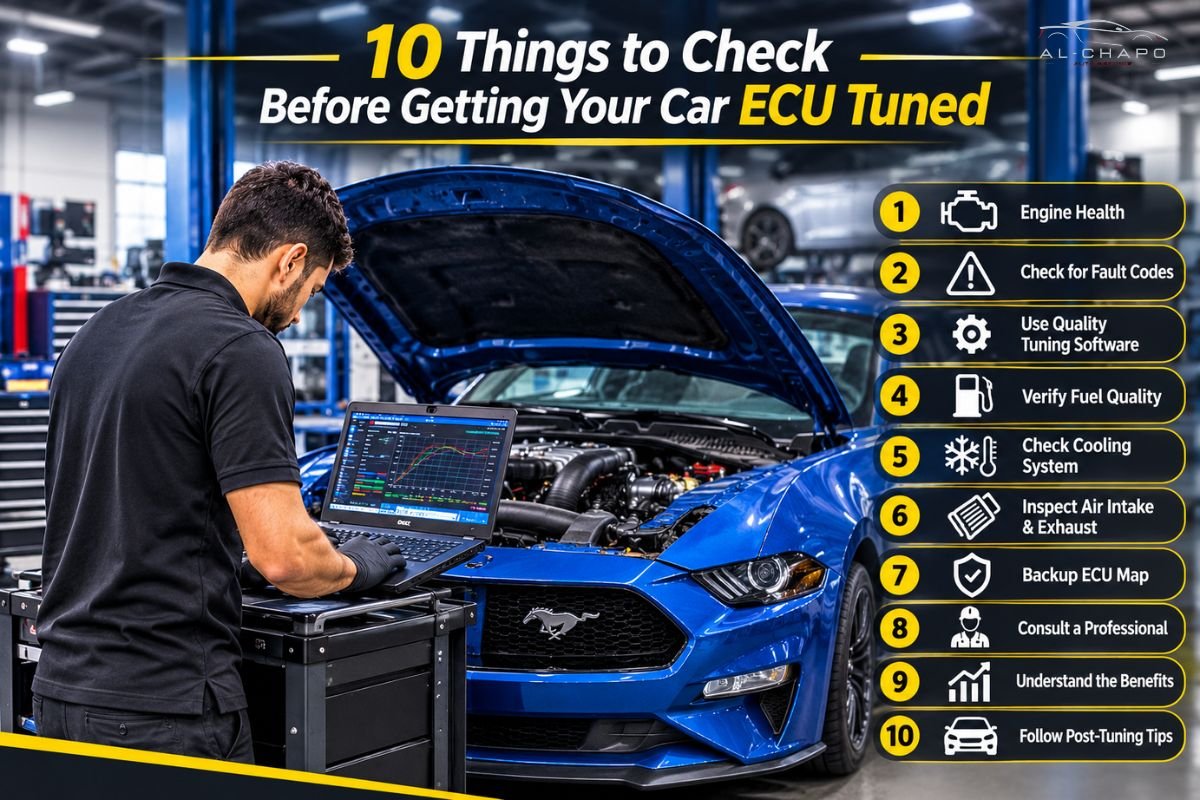
10 Things to Check Before Getting Your Car ECU Tuned
Table of Contents
- Key takeaways
- What is ECU remapping and who needs it?
- Confirm the engine is healthy enough for more power
- Check fuel quality and octane requirements
- Run a full diagnostic scan before anything else
- Verify the tuner’s experience with your make and model
- Ask whether the map is custom or off-the-shelf
- Understand how remapping affects your warranty
- Make sure your cooling system can handle the extra heat
- Check transmission and drivetrain compatibility
- Review emissions and local regulations
- Compare dyno testing, pricing and aftercare
- Quick reference: what separates a good tuner from a risky one
- Wrapping up
- Frequently asked questions
Before making a reservation for ECU remapping in Dubai, you should take into account the engine’s condition, fuel quality, expertise of the tuner, warranty conditions and cooling system functionality. ECU remapping means changing the software that governs the fuel supply, ignition timing and turbo volume, so an inappropriate setting will cost much more than the service.
This guide provides 10 useful tests, from a diagnostic scan to the questions that any reliable workshop must provide clear answers to. In case you own a regular car or a turbocharged vehicle, taking the mentioned steps will lead to increased power of your car.
Key takeaways
- Before loading any map, run a check on the engine health, fuel grade and cooling performance- as tuning accentuates weaknesses.
- When looking into a Best Car Service Center Dubai, request logged data or dyno results from the same type of cars.
- Know what the warranty means, the drivetrain and emissions consequences before booking.
- Make sure to schedule follow-up inspection and clear pricing to safeguard your investment post-tune.
What is ECU remapping and who needs it?
ECU remapping involves the modification of your car’s engine control unit, which alters the performance of the engine. Adjust fuel injection, ignition timing, boost pressure and throttle response to match the engine’s hardware. It is generally sought by owners for greater power or smoother acceleration or better fuel economy.
The concept is straightforward, and it will be very dependent on the car. Modern cars require complex calibration maps to consider emissions, temperature and fuel quality. Therefore, a good tune stays within the confines, and a poor tune exceeds them. Which is why owning a car engine tuning service Dubai expert should begin with an assessment, rather than a lap-top and a downloaded file.
Common reasons drivers look into remapping include:
- A desire for a quicker throttle response for everyday driving or highway passing.
- Adding performance after fitting an intake, exhaust or turbo upgrade
- Enhancing efficiency on long trips within the emirates
- Replacing a factory song that sounds flat or tentative
1. Confirm the engine is healthy enough for more power
Tuning just makes whatever condition your engine is in worse. If the ignition system, seals, or engine are worn, they will not work well with additional boost or advanced timing. A minor problem can become a big problem under extreme conditions.
Always run a simple mechanical test before any map is loaded. A good workshop will generally consider:
- Compression Leak Down Results of all cylinders
- Leaks around gaskets and seals – oil and coolant
- Spark plugs, ignition coils and their overall condition
- Tighten integrity of Turbo, intercooler and boost hose (if fitted)
If any of these demonstrate issues, first resolve them. Remap will not mask mechanical weakness. The mechanical repairs team at Alchapo Auto Service can solve these problems before any performance is done.
2. Check fuel quality and octane requirements
One of the key factors that contribute to a tune’s safety in Dubai is fuel. Most performance maps are based on a given octane rating. Running lower quality fuel than the map calls for, will cause the engine to knock and knock will cause damage to pistons and bearings in a short period of time.
Request the tuner to tell you what the octane requirements are for the new map, and if there is a safety margin for the fuel available in the local area. Follow the recommended grade following the tune, and refuel with fuel from the same source. High temperatures also present an additional hazard because high intake air temperatures increase the risk of knock even when running a high quality fuel.
3. Run a full diagnostic scan before anything else
Stored and pending fault codes should be checked in the car prior to any tune. A misfire, a malfunctioning oxygen sensor or a faulty throttle can cause a tuned car to do erratic things and once new software is added, it becomes more difficult to trace the problem. A good scan will provide you with an accurate history of the car’s condition.
Professional car diagnostic scanner Dubai workshops reads live data, as well as fault codes. Ask for a printout of the results and keep it for your records. Fuel trims, knock retard readings and sensor values are also checked during a test drive for good tuners. Alchapo’s diagnostics and electronics department takes advantage of sophisticated tools for this very step.
4. Verify the tuner’s experience with your make and model
Not all workshops are familiar with all engines. The ECUs vary from platform to platform, which include hardware, security systems, and the way the software is read and written. A tuner who has worked on your actual engine family will be able to identify problems quicker and get around the common pitfalls.
However, when you’re searching for a best car service center Dubai, do not rely on the advertising. Inquire about the number of similar cars that the workshop has tuned, ask to see examples or dyno sheets, and read reviews containing your model.
5. Ask whether the map is custom or off-the-shelf
Several workshops provide pre-loaded empty maps for “stage one”, which are not adapted to a particular car, modifications or climate. Others create special calibrations according to the car’s condition and the goals of the owner. When you are looking for custom work, you can generally expect that it will be more expensive, however, it will most likely be extremely safe and reliable.
Explicitly ask how the map was made. A custom tune should entail logging the car in the road or on a dyno, analyzing the logs and modifying the tune accordingly. When the answer is general, take it as a red flag. Communicate with the tuner about all your modifications, and discuss the workshop’s process of doing performance and customization work to know what a customized build entails.
6. Understand how remapping affects your warranty
A song can have an impact on your manufacturer’s guarantee, particularly during engine, turbo, transmission and electronic components. Dealerships can refuse warranty claims if they can prove a failure was due to altered software. Warranty terms differ across brands and countries so check the terms of your warranty before booking.
Request from the workshop all documentation it keeps, such as the original map, new map and work done. A copy of the stock ECU file is also retained by some owners in case they need to restore the factory calibration prior to a dealer visit. Inquire if the workshop provides any tuning warranty and what it entails. Regular maintenance inspections also give a good service history that could be useful in case of a future claim.
7. Make sure your cooling system can handle the extra heat
The more power you have, the hotter it will get, and we’re in Dubai where the summer is a bit of a concern. Ambient temperatures frequently reach over 40°C and engine bay temperatures can easily rise a lot higher in traffic or long trips. Any tune that includes boost or advanced timing but does not cover cooling can overheat the system.
Before tuning, check the radiator, coolant condition, fan operation and oil cooler, if fitted. A Dubai diagnostic scanner can also record the temperature of the coolant and the air that goes in the intake system during a test drive, indicating if the car maintains its temperature in hot weather. Verify from the tuner if there are any temperature related boost and timing reductions on the map.
8. Check transmission and drivetrain compatibility
The additional torque is driven down the entire drivetrain. There are limits to the clutch, gears, differential, driveshafts and tyres, and a remap can hit them fast. A tune could make a small problem an expensive failure if one component is already worn. A wide variety of services provided by Alchapo encompasses many of these features and can be evaluated at one time during the inspection.
Moreover, inquire about the shift and torque changes in the tune, and if the transmission requires a separate tune. Automatic gearboxes will need coordinated changes to prevent harsh shifts or slipping. If the power level is raised considerably, a manual car might require a more powerful clutch. If the car is scheduled for tuning, discuss these points prior to the first road test.
9. Review emissions and local regulations
Some tunes modify emissions, for example exhaust gas recirculation, catalytic converter monitoring or lambda readings. Changes to emission or noise may not be compliant to local rules. Inspection requirements may be subject to change; please check with the appropriate agency for the current status before taking any action.
Inquire at the workshop about the effect of the tune on the normal operation of emissions systems. A responsible tuner never interferes with monitors which are checked by inspectors, and gives a clear explanation of any changes. Make sure to retain documentation for any changes made, as they may be required for an inspection or insurance review.
10. Compare dyno testing, pricing and aftercare
Price shouldn’t be the only one to consider. A low quote might not include dyno testing, road logging, follow-up adjustments or aftercare. Be aware of the actual cost of each workshop by comparing the content.
Try to find out if they’ve clear and honest pricing, written quotes and clear explanations of what they will get in return. Check whether the tuner provides a follow up check after a couple of hundred kilometers as sometimes the software is fine-tuned after a car has been driven under normal conditions. A reliable car engine tuning Dubai workshop will provide you these details without pressure, in good terms.
Quick reference: what separates a good tuner from a risky one
| Area | Good Tuner | Risky Tuner |
| Engine check | Inspects compression, leaks and ignition first | Loads a map without a health check |
| Map development | Custom calibration based on logged data | Generic file with no explanation |
| Fuel guidance | States octane requirements clearly | Says any fuel is fine |
| Diagnostics | Provides a scan printout and live data | No record of pre-tune faults |
| Warranty | Explains the impact and documents changes | Dismisses warranty concerns |
| Cooling | Checks temperatures and adds safety limits | Ignores heat in summer |
| Aftercare | Offers follow-up checks and clear pricing | Quotes a price with no detail |
Wrapping up
The improvements and the drivability that can be achieved through ECU remapping are genuine, and they’re only going to be genuine when it’s remapped correctly. First, have a Health Check, a clear Fuel Plan, and a tuner that explains all of the changes before they are performed! Obviously, when deciding between ECU remapping services in Dubai, it is important to consider the services they offer, as well as the costs. Alchapo does this via its auto-programming services and diagnostics department.
Frequently asked questions
Can be safe if you give it a conservative, custom map and good fuel to a healthy engine.
Progressions depend on the engine, turbo and fuel quality. Get dyno sheets for cars, do not rely on advertised numbers.
Can impact coverage, particularly engine and drivetrain claims. Maintain copies of original map and new map.
After the first hundred or two kilometers, make an appointment to return for a check-up. Pay attention to knocking, warning lights or high temperatures.