
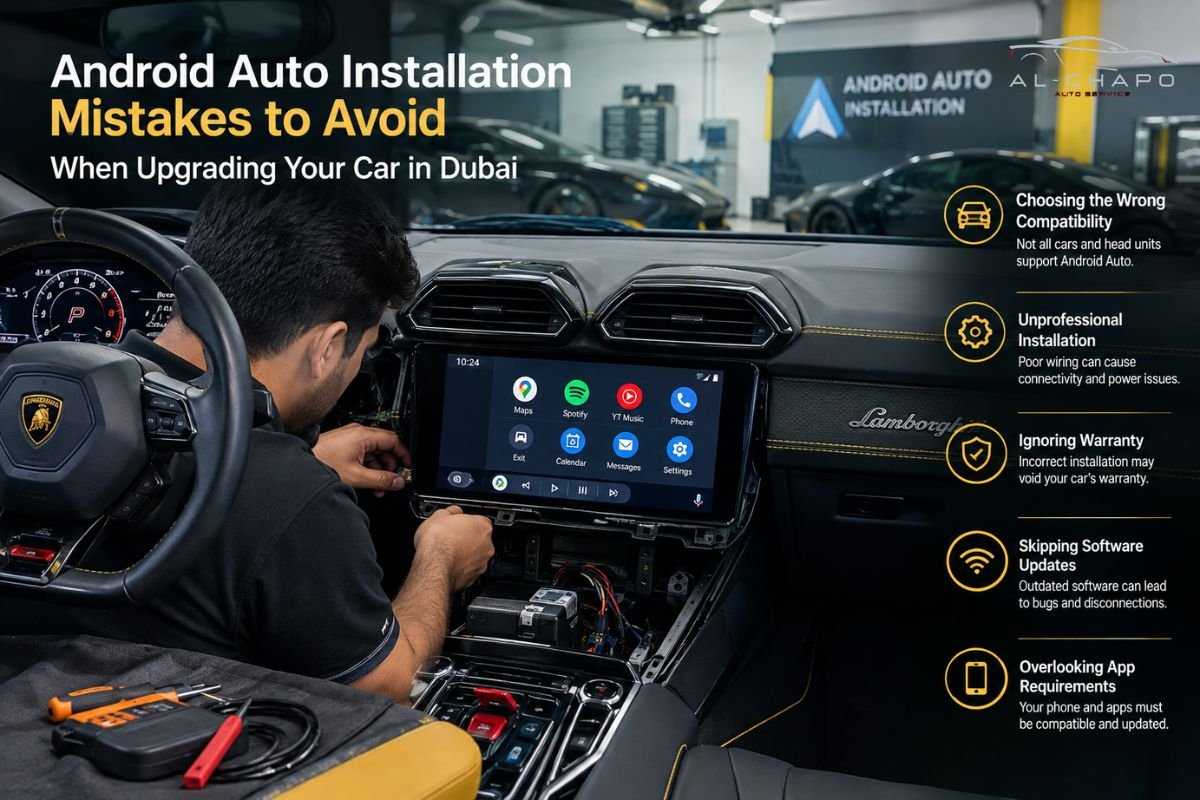
Android Auto Installation Mistakes to Avoid When Upgrading Your Car in Dubai
Table of Contents
- Key takeaways
- Why do Android Auto upgrades fail more often?
- Mistake 1: Buying the wrong head unit for your car
- Mistake 2: Ignoring CAN bus and steering wheel controls
- Mistake 3: Cutting corners on wiring and fusing
- Mistake 4: Skipping professional car stereo installation
- Mistake 5: Overlooking antenna and GPS signal placement
- Mistake 6: Not testing wireless Android Auto before committing
- DIY vs professional installation: A quick comparison
- What does a proper installation in Dubai actually look like?
- Wrapping up
- Frequently asked questions
Android Auto upgrades can go wrong for several familiar reasons, including incorrect choice of head unit according to vehicle trim, wiring shortcuts that bypass the necessary fusing process, ignorance of CAN (Controller Area Network) bus compatibility, and foregoing professional car audio installation in Dubai to opt for DIY installation at home over the weekend. Any of these mistakes can either render the feature inactive or lead to an electrical issue that would only show its symptoms weeks after the upgrade. Therefore, it is essential to identify such mistakes long before the installation is carried out.
Key takeaways
- The wrong head unit often causes Android Auto problems within the first month.
- Rushed wiring can trigger dashboard warnings and battery drain after upgrades.
- CAN-bus interfaces keep steering wheel controls working better than larger screens.
- Experienced Dubai audio installers catch fitment issues that general mechanics often miss.
Why do Android Auto upgrades fail more often?
Dubai’s roads are full of cars from the last ten years that never came with Android Auto from the factory, and owners upgrade them constantly. Most of these upgrades happen fast, either at a market stall or in a driveway, without checking whether the new unit actually matches the car’s electronics. A screen that looks identical to the OEM one online can behave completely differently once it’s wired into a real dashboard.
I’ve had cars come into a workshop where the phone mirroring worked fine but the reverse camera was dead, or the steering wheel volume buttons had simply stopped responding. One customer’s AC display went dark the same week he got Android Auto running, and he didn’t connect the two until we pulled the dash apart. None of that is a coincidence. It’s what happens when an installer treats Android Auto as a plug-and-play accessory instead of a system that has to talk to a dozen other modules in the car.
Mistake 1: Buying the wrong head unit for your car
Even if the physical dimensions of the double DIN unit fit the dashboard, they may not be able to fit it into all the different dashboards. Climate control, parking sensors, and factory amplifiers may also be connected to the stereo system via the module and not around it, depending on the year and model. Then if you buy a generic unit but don’t check this, you miss out on some functions that the car had before the upgrade, and that is the point.
Before selecting a unit, verify:
- If your car has a proprietary connector that requires a wiring harness adaptor.
- Whether the factory amplifier should remain in the loop or be bypassed.
- If it’s a dash trim kit, does it apply to your particular trim level or just your model year?
An automobile audio installation shop in Dubai that can service numerous car makers will typically have this catalogued, reducing a lot of errors and guesswork.
Mistake 2: Ignoring CAN bus and steering wheel controls
This is the one error that is most frustrating once done. The CAN bus network is used in modern cars to share information between the steering wheel, the instrument cluster, and the infotainment system. The low-cost Android Auto devices frequently do not have a legit CAN bus interface, but use a resistive adapter that can interpret only some of the commands from the steering wheel.
Moreover, the phone’s answer button doesn’t work; the volume does. But the trip computer begins to not track the correct mileage. These are not uncommon exceptions. The man who has installed more than a few times looks for a CAN-bus box for a particular model before handling a single wire.
Mistake 3: Cutting corners on wiring and fusing
This is where a “bad install” becomes a real problem. Shortcuts such as splicing wires with electrical tape rather than connectors, connecting power directly to the battery without an intervening fuse, or grounding on a painted surface rather than a metal surface will cost a lot more if they are needed later and will save only fifteen minutes.
One of the most common issues that car owners find themselves in need of car electrical repair Dubai service is loose or unfused connections, which occasionally appear months after the stereo was installed. Your car may have wires that go out of control if the battery drains too quickly, your dash light is flickering, or the fuse blows only on hot days.
Additionally, avoid using the fuse near the battery, or tape instead of solder or crimp connectors, or grounding to a rattly metal bracket instead of a clean ground, and you have created a fire hazard, not an improvement.
Mistake 4: Skipping professional car stereo installation
It’s tempting to be economical with workers and install the unit from home by following the instructions in online tutorials. That may be okay for older, simpler cars when it comes to simple swaps. It typically doesn’t work for anything with factory navigation, a premium sound system, or steering wheel integration.
Car stereo installation in Dubai is more than just a technical task. It includes:
- Setting up the new unit to communicate with the existing sensors and modules in the car.Configuring the new unit to communicate with the car’s installed sensors and modules.
- Testing all functions that interact with the stereo, not only Android Auto
- Checking for no error codes to resolve on the swap.
Furthermore, getting Android Auto up and running at home quickly and easily may leave three other systems quietly broken. Most owners are only aware of it after weeks have passed and the true cause is far more difficult to determine.
Mistake 5: Overlooking antenna and GPS signal placement
Android Auto uses the GPS on the phone most of the time, but there are lots of aftermarket models with a built-in GPS antenna as well that provide navigation and speed information. Attach the antenna under metal trim or behind a heavily tinted windshield, and the signal fades frequently, causing erratic navigation and the unit to lose its position.
Dubai’s sweltering summer is another factor. When mounted on the dash in direct sunlight, antennas often lose their effectiveness sooner, and many mounts fail to hold when the temps get into the 50+ degree range in July. The obvious mounting spot typically doesn’t last and is usually not as convenient as a slightly less obvious but shaded location.
Mistake 6: Not testing wireless Android Auto before committing
While it certainly seems like an upgrade, not all head units support it, and not all phones will connect with all units. Others can cause a slight delay between pressing the screen and the phone reacting, which may be more than welcome when you’re trying to change a route while driving.
If you’re considering a wireless system, ask for a demo call with your own phone, rather than a demo phone the shop has on hand. The stability of the connection between different phones is not the same, so the five-minute test in the shop saves another phone return visit later.
DIY vs professional installation: A quick comparison
| Factor | DIY Install | Professional Installation |
| Wiring safety | Depends on skill and patience | Fused, tested, insulated properly |
| CAN-bus compatibility | Often skipped or guessed | Checked and interfaced correctly |
| Warranty | Usually none | Workshop warranty on labor and parts |
| Time to complete | Several hours, sometimes longer | Typically same day |
| Risk of hidden faults | Higher | Lower, with post-install testing |
Some owners do careful, well-researched DIY installs, and those turn out fine. But the margin for error is thin, and the cost of getting the wiring wrong tends to be higher than whatever labor fee it saves.
What does a proper installation in Dubai actually look like?
At Alchapo Auto Service, an Android Auto upgrade starts with checking the car’s exact trim and existing wiring before any part is ordered, not after. That one step alone avoids most of the mistakes above. The team also runs a full function check post-install, covering steering controls, reverse camera, AC display, and any factory sensors tied into the old unit.
For customers upgrading older cars, Alchapo Auto Service also handles car sound system installation in Dubai as part of the same visit when the speakers or amplifier need attention alongside the head unit, since doing both together avoids opening the dash panels twice. If something about the existing wiring looks off during the swap, that gets flagged before it becomes a bigger issue rather than left for a future breakdown.
Wrapping up
Android Auto upgrades go wrong less because of the technology and more because of shortcuts taken during the install: the wrong unit, rushed wiring, skipped CAN-bus checks, no real test drive before calling it done. Getting it right the first time comes down to matching the unit to your exact car and having someone check every connected system, not just the screen.
Therefore, if you’re planning an upgrade, it’s worth booking a proper car audio installation in Dubai with a shop that tests the whole car, not just the new stereo, before handing back the keys.
Frequently asked questions
Most cars from 2012 onward can support it with the right head unit. Older models may need extra adapters to keep the steering wheel and CAN-bus functions working.
Depends on the phone. It’s genuinely convenient when the pairing is reliable, but test it first since some combinations lag or drop the connection.
Yes. Poor grounding or unfused wiring can cause battery drain, blown fuses, or intermittent faults that only show up weeks after the install.
A straightforward head unit swap is usually three to five hours. Add speakers, amplifiers, or a CAN-bus interface, and it runs longer.
It can, especially on newer cars still under manufacturer coverage. Ask the workshop up front whether the install can be reversed if that matters to you.
Almost always a generic or mismatched CAN-bus adapter instead of one built for your specific make and model.
Usually, yes, as long as the new head unit and harness are compatible with the existing camera feed. Worth confirming before the swap starts.
It can save on labor upfront. Wiring or fitment mistakes tend to erase that saving fast once they need fixing.