Best Budget Car Body Kits That Look Premium
Table of Contents
- Key takeaways
- What actually makes a body kit look “premium”?
- Material choices that affect price and finish
- Budget vs premium: what you’re really paying for
- Popular budget-friendly kit styles in Dubai
- RTA rules and compliance you need to know
- Installation: what to expect and how long it takes
- Common mistakes car owners make
- How to choose a reliable installer?
- Conclusion
- Frequently asked questions
If you put your efforts on three elements only, a cost-effective body kit really looks good. Those are fitment quality, colour-matched finish, and the right material for every piece. Bumpers and side skirts made of ABS plastic or polyurethane instead of fiberglass are good for low-budget builds.
You shall pay much less for partial kits (front lip, side skirts, rear diffuser) than for a full package. Proper installation, applying good primer, and matching paint are much more important than brand reputation for your body kit. Please remember to check RTA compliance before changing your bumper style and adding aggressive components.
Key takeaways
- The selection of the right material is more important than its cost for getting the desired finish.
- Partial kits allow you to have an amazing car without spending too much money.
- Installation by professionals can give a much more luxurious look to affordable kits.
- Be aware of UAE regulations regarding body kit installation.
What actually makes a body kit look “premium”?
- Gaps between panels: That is the most common indicator of badly fitted body kits, regardless of their price. If your lip does not align perfectly with the bumper or if the side skirts are not flush with the door sill, the message that your car has been extensively modified cheaply is conveyed, irrespective of the good quality of the used materials.
- Paint matching: This is the second consideration. A kit using the correct color code and painted in-house will look far more cohesive than the kit using a primer coat or a mismatched color coat. This is where a lot of that premium feel comes from, rather than from the kit design.
- Proportion: This is the next consideration. Kits that have oversized diffusers or fuel-efficient side skirts on a small car tend to look obviously aftermarket. A well-designed kit considers the car’s proportions, making even the simplest kit look more factory-like.
Material choices that affect price and finish
- ABS Plastic
This is the most frequently used budget material for bumpers, lips, and skirts. It features good impact resistance, good paint adhesion, and is much cheaper to manufacture than fiberglass. The only drawback is that for very large aero parts, it is not quite as rigid, but for lips and skirts or smaller add-ons, it is quite effective.
- Polyurethane (PU)
Slightly more expensive than ABS, but more flexible, which is important because PU performs better in Dubai’s hot climate regarding cracking due to expansion than rigid plastics. It’s an excellent compromise for those who desire durability without paying fiberglass prices.
- Fiberglass
It is lighter and more durable, mostly used for full aero kits and track-oriented cars, while it is also more brittle and likely to crack when experiencing curb strikes or driving over speed bumps, which is certainly something to think about considering the number of low parking ramps and speed bumps all over Dubai malls and living areas. Additionally, if damaged, it is the most expensive option to repair.
- Carbon fiber
The top choice option for car parts, mainly used for splitters, mirror caps, and other small car parts, since that leads to very high costs, as the price of full carbon fiber kits is rather high. Usually not regarded as a budget option.
Therefore, in the case of a typical car body kits Dubai, it’s usually safe to say that it will be ABS or PU, as fiberglass brings lots of fragility issues motorists would like to avoid.
Budget vs premium: what you’re really paying for
| Factor | Budget Kit | Premium Kit |
| Material | ABS/PU | Fiberglass/Carbon |
| Typical scope | Partial (lip, skirts) | Full aero package |
| Paint work | Standard color match | Multi-stage, blended |
| Installation time | 1–2 days | 3–5 days |
| Fitment tolerance | Good with skilled installer | Factory-tight |
| Durability in UAE heat/roads | Good (PU) to fair (ABS) | Fair (fiberglass), excellent (carbon) |
However, the biggest price gap between budget and premium kits isn’t really the plastic itself. Raw ABS and fiberglass aren’t that far apart in material cost. It’s labor, paint quality, and how much bodywork prep goes into blending the kit with the factory panels. That’s exactly where it makes sense to spend a little more, even on an otherwise budget build.
Popular budget-friendly kit styles in Dubai
- Front Lip Spoilers
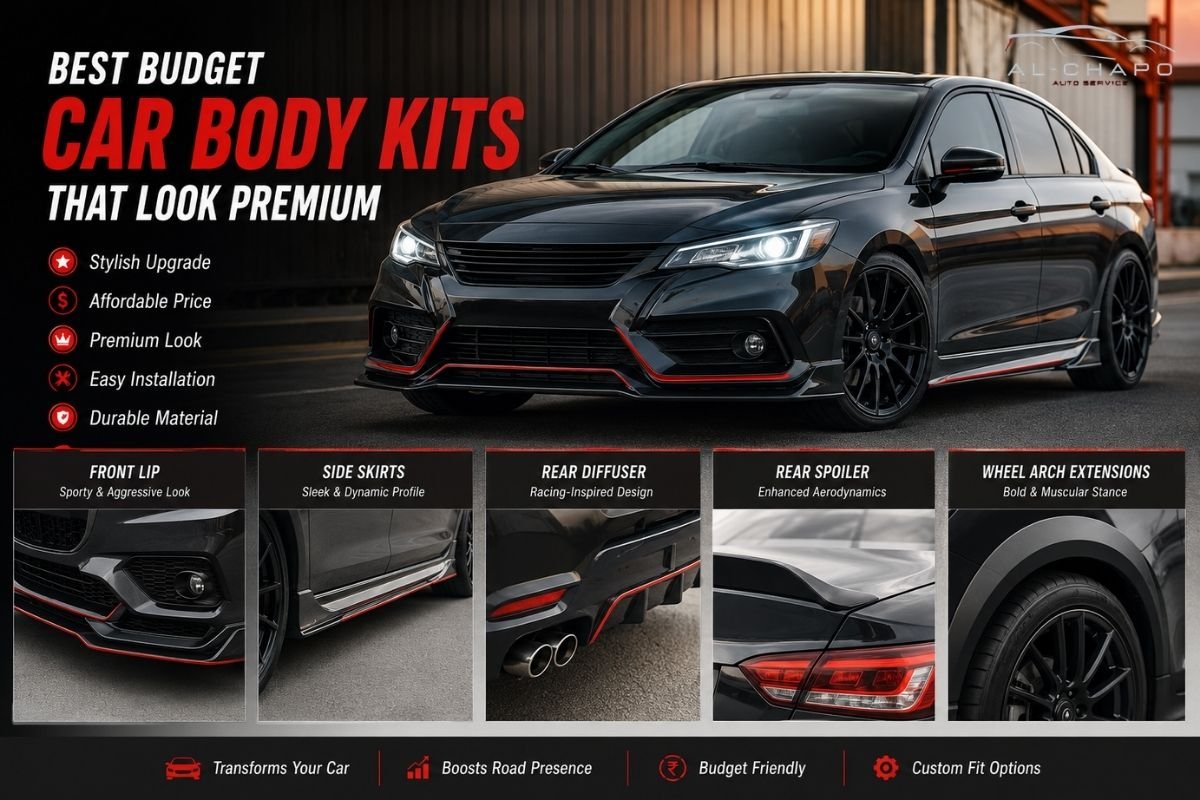
The single most cost-effective upgrade. A front lip changes the stance of the car more than almost any other single piece, and it’s one of the cheaper components to source and fit.
- Side Skirt Extensions
These lower the visual line of the car and make it look wider and more planted. Because they’re a smaller surface area than a full bumper, they cost less to paint and install.
- Rear Diffusers
A diffuser adds visual aggression to the rear without touching the bumper itself in most cases, which keeps installation simpler and cheaper than a full rear bumper replacement.
- Fender Flares (Mild)
Popular on SUVs and pickups, common in the UAE. Mild flares add width without the cost of a full widebody conversion.
- Partial Kits vs Full Kits
Choosing two or three of the above instead of a complete front-to-rear aero package is the single biggest budget lever available. Most of the visual transformation people want comes from the front lip and side skirts combined. The rear pieces matter less for how the car reads at a glance.
RTA rules and compliance you need to know
Vehicle modifications in the UAE, including body alterations, aren’t unregulated. A technical regulation system developed by the Emirates Authority for Standardisation and Metrology, in coordination with the RTA, Ministry of Interior, and other partners, sets requirements that car service centers and workshops must follow when modifying passenger vehicles, covering changes made through the addition, substitution, or alteration of vehicle equipment or systems.
This matters practically in a few ways:
- Bumper and body modifications shouldn’t obstruct or alter the function of lighting, license plate visibility, or safety equipment.
- Extreme width increases (wide-body fender flares that extend well beyond the factory track) may require additional approval or fail registration renewal inspection.
- Dubai Police actively enforces against modifications that affect road safety or contribute to noise and reckless driving. In past enforcement campaigns, thousands of vehicles were fined or seized in a single year for illegal modifications, so this isn’t a rule that only exists on paper.
- Vehicles go through periodic RTA testing that checks body condition among other safety parameters, so a poorly fitted kit that damages panel alignment or lighting function can actually cause a test failure.
None of this means body kits are banned. It means legitimate Car Body Kit Services in Dubai providers should be able to tell you, before installation, whether a specific kit design is likely to cause registration or inspection issues. If an installer can’t answer that question, that’s worth noting.
Installation: what to expect and how long it takes
A partial kit (front lip plus side skirts) with proper paint matching typically takes one to two working days at a competent shop, factoring in prep, primer, paint, and cure time. Full kits with more extensive bodywork blending can run three to five days.
Rushed installation is where most budget kits go wrong. Paint that hasn’t cured properly, adhesive that hasn’t set before the car goes back on the road, or panel gaps left unaddressed because the shop is trying to turn the car around same-day: these are the shortcuts that make a budget kit look budget.
Ask specifically how the shop handles paint blending between the new kit and the factory panels. A shop that blends the paint into the adjacent factory panel, rather than just painting the kit piece in isolation, will produce a noticeably more seamless result.
Common mistakes car owners make
- Choosing a kit design before checking fitment for the exact trim level- Bumper shapes vary between trims and model years even within the same generation. A kit made for a different trim often needs extra cutting or filling to fit, which shows.
- Skipping test-fitting before paint- A kit should be dry-fitted and adjusted before it goes anywhere near a paint booth. Painting first and adjusting later almost always leaves visible seams or filler lines.
- Going straight for a full kit on a tight budget- This usually means cutting corners somewhere: cheaper paint, rushed installation, or a lower-grade material, rather than doing a partial kit properly.
- Ignoring ride height and wheel fitment- A lip or skirt kit that sits too close to the road on Dubai’s speed bumps will get scraped and cracked within weeks. Matching the kit to a realistic ride height for daily driving matters as much as the kit design itself.
- Not asking about warranty on paint and adhesion- Paint peeling or adhesive failure from UAE heat is a known issue with poorly prepped installations. A reasonable warranty is a sign the shop stands behind its prep work.
How to choose a reliable installer?
Look at actual completed work, not just kit catalogs. Any shop can show you a kit on a shelf; ask to see cars they’ve painted and fitted themselves, ideally in person rather than only photos.
Moreover, ask direct questions about material sourcing, paint process, and expected timeline. A shop confident in its process will answer specifically rather than vaguely. Confirm whether the quoted price includes paint, prep, and any bodywork blending, since some quotes only cover the raw kit and installation labor separately.
For owners comparing car body kit installation Dubai providers, it’s worth getting two or three quotes for the same scope of work: partial kit versus full kit, same materials, since pricing and included services vary more between shops than most people expect.
Conclusion
A body kit doesn’t need a premium price tag to produce a premium result. Fitment accuracy, correct material choice for the piece, and proper paint blending do more visual work than the sticker price of the kit itself. Sticking to a partial kit, choosing ABS or PU over fiberglass unless you specifically need the stiffness, and confirming compliance before committing to an aggressive design will get most Dubai owners a genuinely premium-looking result without an inflated budget.
If you’re weighing your options, Alchapo Auto Service works through fitment, material, and compliance questions with owners before any cutting or painting starts, which is generally the stage where budget builds either succeed or go sideways.
Frequently asked questions
The total aero package isn’t necessarily the cheapest option, as it usually includes paintwork and other labor-intensive items, as well as the basic bodywork, which is usually made of ABS or PU.
Polyurethane is a good medium-range material, and is better known for its ability to withstand heat and thermal expansion than rigid ABS or fiberglass.
It can, if modification impacts lighting function, plate visibility or overall body condition determined during testing. Check with installer before installation.
It takes 1-2 working days to get a partial kit, and 3-5 days or more for a full kit with more detailed blending.
While it may be possible to match simple bolting pieces of paint, it is not easy without the correct tools and equipment, and if it goes wrong, it can be expensive to correct it later.
Higher than factory widths may need extra approval or may result in problems at inspection, so please check before installing.
Most of the aero transformation a person desires is achieved with a partial kit, which typically includes only a front lip and side skirts, instead of a complete kit, which costs more.
Inquire about the type of materials used, if paint blends into factory panels, the time frame, and what the warranty covers for paint and adhesion problems.