
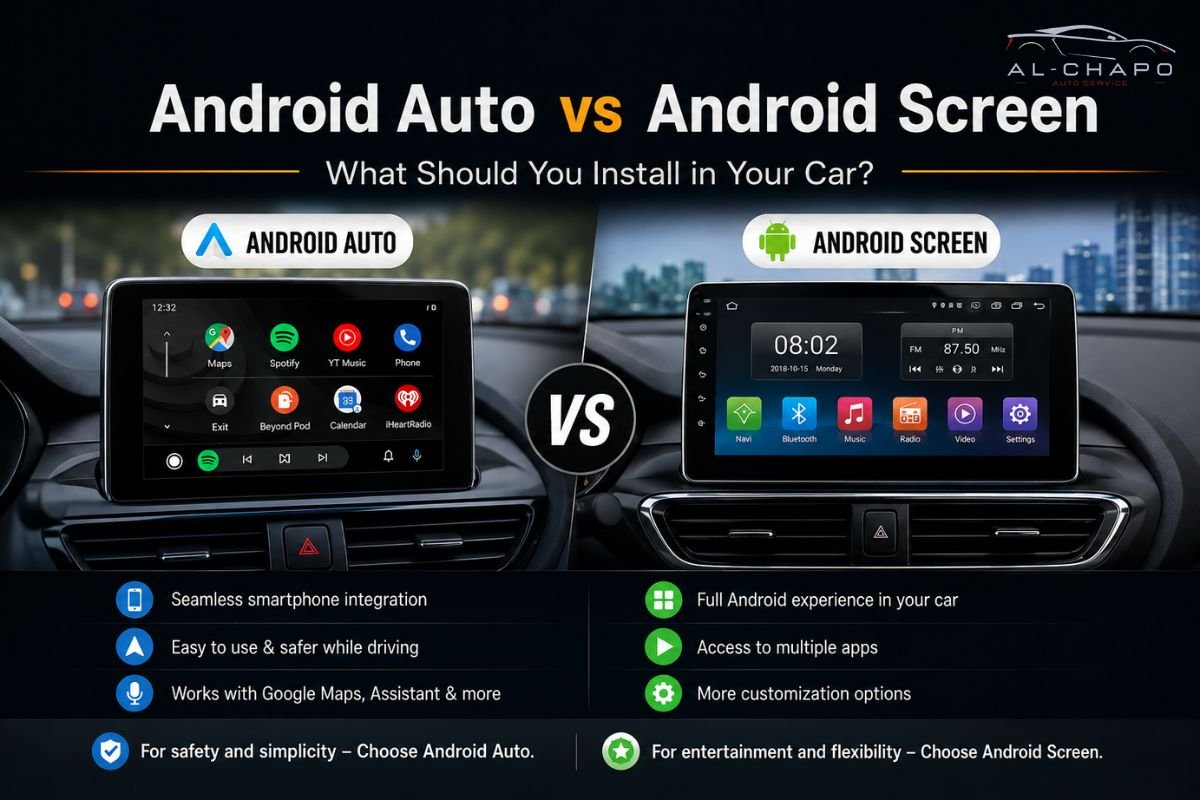
Android Auto vs Android Screen: What Should You Install in Your Car?
Table of Contents
- Key takeaways
- What does Android Auto actually do in your dashboard?
- What does an Android screen (Android head unit) offer instead?
- Android Auto vs Android screen: A direct comparison
- Which one fits your driving habits?
- Why does professional installation change the outcome?
- Common mistakes car owners make
- What does the installation process look like?
- Where does this fit into bigger car modification plans?
- Final thoughts
- Frequently asked questions
The phone features of the Android Auto interface work with your car’s system and need your phone to be connected each time you drive. Android screen is an independent head unit that runs Android by itself with built-in apps, GPS, and storage, whether you have a phone or not. If you want navigation, calls, and music without complications, then Android Auto is sufficient.
If you wish to have more functions, offline applications, cam integration, and a unit that allows you to listen to media in case your phone is out of battery, then a head unit is a better purchase. In any case, using any of the systems mentioned relies not on how good the unit is but primarily on the skill of the installer.
Key takeaways
- Android Auto is reflected in your device, while Android screens function without a phone.
- Android screens are pricier, but they supply apps running on two screens, navigation, and recording capability.
- Generally, the low-quality wiring leads to the breakdown of the installation, it doesn’t matter what the type and brand of the screens.
- Hire professionals for car audio system installation in Dubai who understand the factory wiring in your vehicle well.
What does Android Auto actually do in your dashboard?
It is essential to note that Android Auto does not qualify as a computer; it merely functions as a projection layer. Once the user’s phone is plugged in or connected via Bluetooth, the interface of the device is displayed on the screen of the car, which includes applications such as Maps, phone calls, and texts read out loud from the user’s device.
Nonetheless, the main advantage of this interface is that it is uniform, as the behavior is regulated by Google, meaning that there are no differences from car to car. Everything gets updated using the phone, as there is no need to wait for the car manufacturer to release an upgrade.
The disadvantages are that Android Auto relies entirely on smartphones as required, so without a phone installed, Android Auto cannot function correctly. Furthermore, when the battery charge is low, Android Auto starts lagging. Finally, only a limited selection of applications approved by Google can be used by Android Auto, so users cannot access all of the things available on their smartphones.
What does an Android screen (Android head unit) offer instead?
An Android head unit is unlike anything else. It is a small tablet embedded into your vehicle’s dashboard and runs its version of Android, complete with its storage, processing, and internet connection.
You can download any application from the Play Store instead of only those that Google approves for driving purposes. Offline maps can function without phone support. There are many units on the market that provide the ability to use the split-screen so that navigation runs on one side of the screen while a reverse camera feeds the other half of the screen. Our device can display different functions at the same time, such as a dash cam, a tire pressure monitor, an OBD scanner, and more.
Moreover, the complexity of the modern car sound system is its trade-off. For a system that has many moving parts, something is likely to go wrong. If the setup is inaccurate, the performance could be worse than what the factory system had to offer. It is on this note that taking shortcuts when getting a car sound system installation in Dubai becomes evident in less than a month.
Android Auto vs Android screen: A direct comparison
| Feature | Android Auto | Android Screen (Head Unit) |
| Works without a phone | No | Yes |
| App selection | Limited, Google-approved | Full Play Store access |
| Offline navigation | No | Yes, with downloaded maps |
| Setup complexity | Low | Moderate to high |
| Software updates | Through phone | Through the unit itself |
| Split-screen / multitasking | No | Yes, on most units |
| Cost | Often built-in or low-cost add-on | Higher, depends on brand and specs |
| Long-term reliability | Depends on phone condition | Depends on installation quality |
Therefore, a weekend driver who just wants directions and music doesn’t gain much from paying more for a full Android computer in the dash. Someone who drives for work, films dash cam footage daily, or wants a permanent reversing camera feed will outgrow Android Auto pretty quickly, usually within a year of daily use.
Which one fits your driving habits?
Think about how you actually use your car, not how you imagine using it.
Short trips, a few calls, music through Spotify: Android Auto covers that without any extra hardware. It’s already built into most cars sold in the UAE from the last five or six years, so there’s a decent chance you don’t need to spend anything at all.
Long drives, a dash cam that records continuously, navigation in areas with patchy signals, and an Android screen earn its cost back in convenience. It’s also the more sensible pick if you’re customising your car more broadly, since it pulls reversing cameras, parking sensors, and other add-ons into one interface instead of scattering them across separate screens.
The demand for this kind of upgrade isn’t slowing down either. Industry estimates put the global car audio market at roughly AED 43.6 billion in 2026, projected to grow to AED 76.1 billion by 2034, and the Middle East is riding that same curve, with rising vehicle ownership pushing more drivers toward premium in-car systems. It’s part of why more Dubai garages now run dedicated car modification services in Dubai built around infotainment, not just cosmetic work.
Why does professional installation change the outcome?
The screen you choose matters less than who installs it. That’s the part most people find out the hard way.
A cheap Android head unit fitted correctly, with proper wiring, fused connections, and a harness matched to your exact car model, will outlast an expensive unit thrown in carelessly. Loose grounding causes flickering screens. A mismatched harness can quietly disable your steering wheel controls without anyone noticing until weeks later.
Good car audio installation in Dubai comes down to knowing which head units suit your specific make and year, and wiring them so nothing behind the dash rattles loose after a few months of heat and vibration on Dubai’s roads. Nobody notices good wiring. They only notice bad wiring, usually at the worst possible time.
Common mistakes car owners make
A lot of installation problems trace back to the same handful of decisions. People buy the screen before checking whether it actually fits their dashboard trim, and find out too late that even the same car brand can vary between models. Universal wiring harnesses are another one: they’re convenient, but they often disable factory features like parking sensors or steering wheel controls without warning.
Heat is an underrated culprit too. Android units run warmer than factory stereos, and without proper ventilation, direct UAE sun can cook a unit within a season. A fair number of owners pick an installer purely on price, then wonder why the wiring gauge feels thin, or the connectors look reused six months in.
However, one thing worth checking before you leave the shop: GPS and SIM reception. Some units lose signal entirely inside underground parking, and that’s not something you’ll catch sitting in the garage with the engine off.
What does the installation process look like?
A proper fitting runs through a few stages, and asking about them upfront tells you a lot about a shop’s standards.
The technician starts by checking your car’s exact trim and year against the head unit’s compatibility list. From there, they source or build the correct wiring harness rather than forcing a universal one onto it. The unit gets mounted, wired, and tested function by function, not just the screen turning on, but reverse camera, steering controls, climate display, and Bluetooth calling too. A road test comes last, because some issues, like signal drop or screen glare, only show up once you’re actually driving.
This is roughly the standard Alchapo Auto Service follows for car stereo installation in Dubai. Worth asking any shop you’re considering whether they do the same before handing over your keys.
Where does this fit into bigger car modification plans?
For a lot of drivers, an audio or screen upgrade isn’t really a standalone project. It tends to be the first step toward something bigger, paired later with a reversing camera, a dash cam, or sound insulation.
If that’s the direction you’re leaning, it’s worth planning the wiring for future additions during the first installation instead of redoing it later. A technician who understands the full range of car modification services in Dubai can route extra wiring for a dash cam or amplifier now, even if you don’t install it for another six months, which saves you from opening the dash panel twice.
Final thoughts
Android Auto and an Android screen solve different problems. One mirrors your phone for simple trips. The other replaces your dashboard’s brain entirely. Neither is a wrong choice on its own, but picking the mismatched one for how you actually drive gets expensive fast, especially once installation costs are added in.
Still deciding? Book a short consultation before committing to a unit. Alchapo Auto Service can walk you through what fits your car’s factory wiring, what your daily driving actually needs, and what’s worth paying extra for versus what isn’t.
Frequently asked questions
Yes. Most cars with factory Android Auto can be upgraded to a standalone Android head unit, though the wiring harness usually needs replacing to fit properly.
A little, since it draws power even when parked for GPS or background updates. A good installation includes a cutoff relay so it doesn’t drain the battery overnight.
Yes. You only pay if your car doesn’t already support it and needs a compatible head unit installed to run it.
Android screens usually integrate dash cam footage right into the main display. Android Auto has no native way to show that feed at all.
It can, depending on the manufacturer. Ask whether the harness used is reversible, so the original setup can go back in if needed.
A straightforward job takes three to five hours. Cars needing extra integrations, cameras, sensors, and the like can take a full day.
Yes, most modern head units support both. Switching between an iPhone and an Android phone in the same car isn’t an issue.
It does. Cheaper units overheat or dim in direct sun. Ones with proper ventilation and heat-resistant parts handle Dubai’s climate noticeably better.
Poor wiring, almost always, not a faulty screen. Loose connections and mismatched harnesses cause most of the flickering and freezing owners report.
Usually, yes. Proper compatibility and wiring checks prevent the recurring faults that come from rushed installs at general garages.