
Android Auto Retrofit in Dubai: How to Add Android Auto to an Older Car
Table of Contents
- Key takeaways
- What does android auto retrofit actually mean?
- Signs your car is a good candidate
- Wired vs wireless retrofit kits
- What does the installation process look like?
- Cost factors to expect in Dubai
- Wired vs wireless: A quick comparison
- Mistakes people make with DIY kits
- Choosing the right shop for car modification services
- Bottom line
- Frequently asked questions
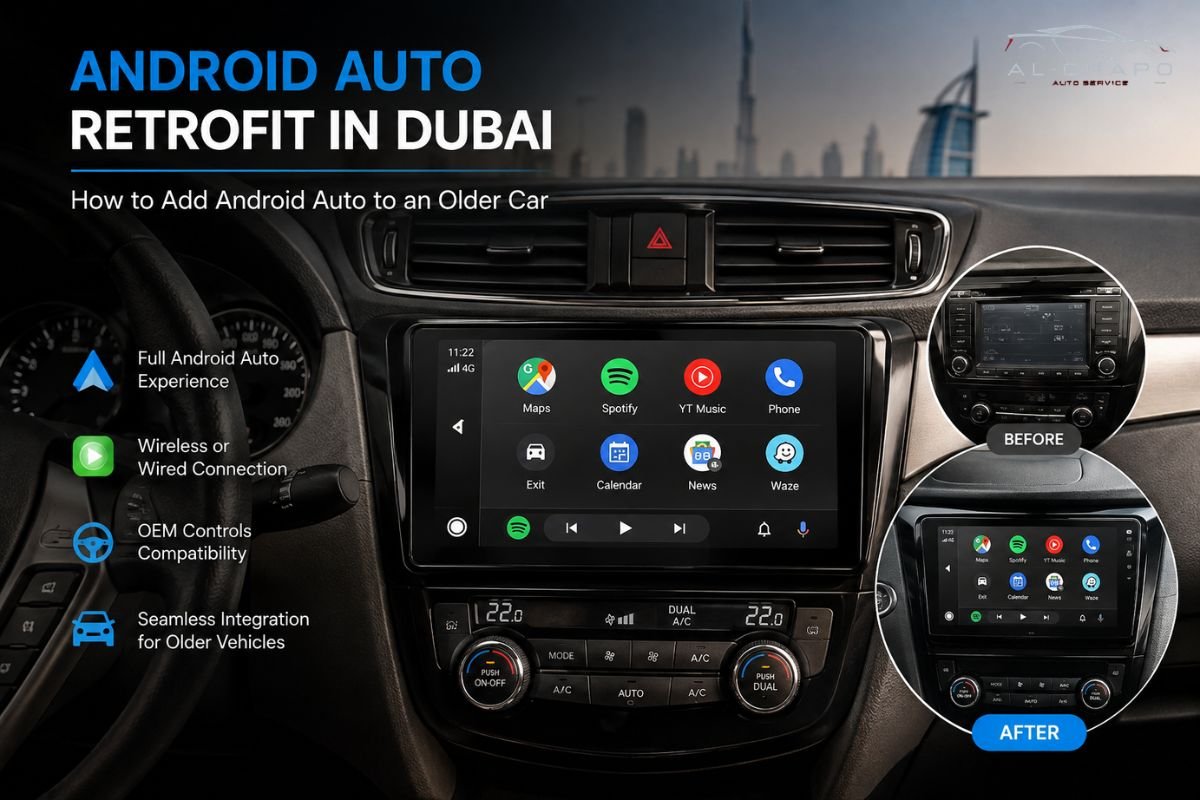
Modifying an old car to make it compatible with Android Auto is an easy process that involves swapping out the old stereo (or adding an adapter wiring unit) and replacing it with a new device that allows for connection through USB or Bluetooth. An installation job can take two to four hours in Dubai and costs anything from AED 400 to AED 2,500+ for a complete and functional device.
According to Google, the number of Android Auto-enabled cars reached more than 250 million by the end of 2025, which is 50 million more than in previous years, proving that the popularity of such retrofitting keeps growing and increasing its demand. You only need to make a choice whether you want the wired or wireless unit.
Key takeaways
- To make use of Android Auto retrofits, you will require suitable head units or specific wireless adaptors.
- Additionally, wireless kits entail a higher initial cost, although they provide better convenience on a daily basis because they do not use any wires.
- The market for wireless CarPlay and Android Auto adaptors reached AED 6.6 billion globally in 2025.
- Expert car audio system installation in Dubai ensures that cabling and control problems do not arise.
What does android auto retrofit actually mean?
Retrofitting is the term used for adding Android Auto to pre-2020 models of cars that did not include it before or came equipped with outdated versions. This is familiar with cars manufactured in the years from 2014 to 2019 since the proper inclusion of Android Auto became usual in the automotive industry after that.
Retrofitting can be done in two different ways. The first option involves replacing the factory head unit with an aftermarket one that features Android Auto. The second option entails keeping the factory display and using a small adapter box located usually in the dashboard part of the car’s interior, which takes the needed signal and transfers Android Auto to the existing screen. Both ways are considered car audio installation in Dubai; however, this installation is done differently.
Moreover, adopting the method with an adapter box is preferred by the owners of premium cars. For example, Mercedes, BMW, and Audi vehicle owners would not want to use their new car navigation and climate control functions.
Signs your car is a good candidate
Not every car is equally easy to retrofit. A few things determine how smooth the job will be:
- Steering wheel controls- Cars with buttons for volume, calls, or voice assistant need a steering wheel control interface module to keep those functions working with a new head unit.
- Screen size and shape- Aftermarket units come in fixed sizes. If your dashboard has an unusual design screen, instead of just replacing the screen, you might need an adapter or a custom trim panel.
- Amplifier and speaker wiring- BMW and Mercedes are two major brands that use special amp systems; therefore, you’ll need a specific wire harness to prevent losing quality sound or blowing a fuse.
- Existing backup camera- You should check that the new device is compatible with your current camera, as otherwise you’ll not be able to use it anymore.
A decent shop offering car stereo installation in Dubai will check all four of these before quoting you a price, not after.
Wired vs wireless retrofit kits
Wired kits are simpler and cheaper. You plug your phone in with a USB cable every time you drive, and Android Auto launches automatically. There’s less that can go wrong, and the connection is generally more stable for things like navigation, which drains a fair bit of processing power.
Wireless kits use Wi-Fi Direct to mirror your phone’s screen without a cable. Once paired, the car remembers your phone and connects automatically within a few seconds of starting the engine. You stop fumbling for a cable every time you get in, and the console stays clear of a wire trailing across it.
Furthermore, the catch is reliability. Wireless connections can lag slightly during voice commands or when switching between apps, and older Android phones with weaker Wi-Fi chips sometimes struggle to maintain a stable link. If your daily use is mostly navigation and music, wireless works fine for most people. If you’re on video calls or use Android Auto for work constantly, wired still edges it out on stability.
What does the installation process look like?
A full head unit retrofit generally follows this sequence:
- Diagnosis- The technician checks your car’s wiring, screen compatibility, and whether a steering wheel interface or CANbus adapter is needed.
- Dashboard removal- Trim panels around the factory unit are carefully removed, which takes longer on some German and Japanese models with layered dash designs.
- Wiring harness connection- The new unit connects through a plug-and-play harness matched to your car’s model, so factory wiring isn’t cut.
- Unit mounting and testing- The head unit is secured, connected to Android Auto, and tested with both a wired and wireless phone if applicable.
- Trim reassembly and calibration- . Panels go back on, and the technician checks that steering controls, reverse camera, and speaker output all work correctly.
For an adapter-based retrofit, the process is faster since the factory screen stays in place. It usually skips steps 2 and 5 almost entirely.
Cost factors to expect in Dubai
Pricing depends on the car, the kit, and the labor involved, not just the head unit itself. Here’s roughly what shapes the final bill
| Factor | Impact on Price |
| Head unit brand and screen size | AED 400–1,800 depending on quality and screen size |
| Wireless adapter box (keeps factory screen) | AED 600–1,200 |
| Steering wheel interface module | AED 150–400, needed for most European cars |
| Labor (wired swap) | AED 150–300 |
| Labor (adapter, no dash removal) | AED 100–200 |
| Backup camera integration | AED 100–250 if not already compatible |
A basic wired retrofit on a Japanese or Korean sedan can land around AED 700 to 900 all-in. A wireless setup on a European car with a steering wheel module and camera integration can reach AED 2,000 to 2,500. Shops offering full car modification services in Dubai will usually bundle labor into the quoted price rather than charging it separately, so it’s worth asking upfront what’s included.
Wired vs wireless: A quick comparison
| Features | Wired Retrofit | Wireless Retrofit |
| Upfront cost | Lower | Higher |
| Daily convenience | Requires cable each time | Connects automatically |
| Connection stability | More consistent | Can lag on older phones |
| Phone battery drain | Charges while connected | Drains battery unless paired with wireless charging |
| Typical install time | 2–3 hours | 3–4 hours |
Mistakes people make with DIY kits
A lot of owners try to save money by buying a generic Android Auto head unit online and fitting it themselves. It doesn’t always go badly, but a few problems come up often enough to mention.
- Cheap units sometimes list Android Auto support that turns out to be an unofficial mirroring app rather than the real Google-certified interface. It looks similar in photos but lags badly and doesn’t get software updates.
- Skipping the steering wheel interface module is another common one. People assume the buttons will “just work” after swapping units, and they don’t, because the factory wiring speaks a different protocol than the generic aftermarket unit expects.
- Reverse camera wiring gets crossed occasionally too. If the polarity or trigger wire isn’t matched
- held correctly, the camera either doesn’t switch on automatically or stays on permanently. Both are annoying, and the second one is genuinely distracting while reversing.
None of these are disasters, but they usually mean paying a shop to fix a DIY job anyway, which ends up costing more than getting it done right the first time through a proper car audio installation in Dubai service.
Choosing the right shop for car modification services
A few questions are worth asking before booking:
- Does the quote include the steering wheel interface module, or is that an add-on you’ll discover later?
- Will they show you the exact head unit model before installing it, rather than a generic listing?
- Do they offer a warranty on both the unit and the labor, separately?
- Can they source OEM-style trim panels if your dash needs one for a clean fit?
However, a shop that answers these clearly, without vague reassurances, is usually one that’s done enough of these jobs to know where things go wrong. Alchapo Auto Service handles this kind of work regularly, checking wiring compatibility and steering controls before quoting so there are no surprises once the dashboard is already apart.
Bottom line
Retrofitting Android Auto into an older car isn’t a big gamble anymore. The parts, the labor, and the price range are all predictable once you know what your dashboard actually needs. What matters is getting two decisions right: wired versus wireless, and full head unit swap vs keeping your factory screen with an adapter. Confirm the shop includes the steering wheel module and camera integration in the quote, and the rest is routine work for anyone who does it regularly.
Frequently asked questions
Almost any car with a standard double-DIN or single-DIN dash opening can be retrofitted. Very old cars without a factory stereo bay may need a custom fascia panel first.
It can, if the car is still under manufacturer warranty and the work involves cutting factory wiring. Plug-and-play harnesses usually avoid this issue entirely.
Most wired retrofits take two to three hours. Wireless kits with camera and steering wheel integration can take three to four hours depending on the car.
Only if the shop skips the interface module. With the right adapter installed, volume, call, and voice buttons keep working normally.
Yes, reliability comes from the phone and unit hardware, not ambient temperature, as long as the car’s electronics stay within normal operating range.
Yes, through an adapter box that connects behind the existing screen without replacing it, which is popular for cars with premium factory displays.
Not necessarily. Screen size affects visibility, not processing speed. A smaller unit with a better processor often runs Android Auto smoother than a large budget screen.
Yes, as long as the new unit or adapter is matched to your camera’s input type. This should be confirmed during the pre-installation check.
For most sedans, a wired head unit with steering wheel integration typically runs between AED 700 and AED 1,000, including labor.
Yes, a reputable installer will demonstrate Android Auto connecting and steering controls functioning before final payment, not just before installation begins.