
Monthly Car Routine Maintenance Checklist Every Dubai Driver Should Follow
Table of Contents
- Key Takeaways
- Why does Dubai’s climate change the maintenance game?
- Weekly checks you can do yourself
- The monthly checklist
- Comparing DIY checks vs professional inspection
- Common maintenance mistakes Dubai drivers make
- What does a professional service actually cover?
- Expert insight
- Bottom line
- Frequently asked questions
Key Takeaways
- Dubai’s climate of extreme temperatures and sand creates wear and tear on tires, fluids, batteries, and air conditioning.
- Regular checks of tires, fluids, brakes, and the battery help keep costly automotive failure at bay.
- Basic maintenance is easily understood, although certain services require advanced technicians and sophisticated equipment.
- Routine maintenance can cut repair costs by avoiding expensive breakdowns and costly roadside assistance calls.
Cars in Dubai face much tougher conditions than cars in cooler climates. High temperatures can severely affect tires, the vehicle’s engine oil, the coolant, and the AC system. Hence, discovering problems with the automobile once a month must always be performed, as car checks should not be skipped. Checking the car regularly leads to eliminating the chance of breakdowns, enhances vehicle performance, and keeps the automobile running without issues. Implementing the idea of following a simple monthly auto maintenance procedure and getting car services regularly will help to keep the car in good working condition and avoid expensive repairs.
Why does Dubai’s climate change the maintenance game?
Most service schedules in car owners’ manuals were developed with a temperate environment in mind since they are closer to Germany or Japan than the Gulf states. This fact is much more important than many drivers think.
Additionally, rubber components such as tires, hoses, and rubber belts deteriorate much faster when subjected to prolonged heat conditions. Engine oil breaks down quicker once cabin and engine bay temperatures stay elevated for months on end. Batteries have a shorter working life here too. Heat speeds up the internal chemical reactions that eventually kill a battery, which is why one rated for five years elsewhere might only last three in Dubai.
Sand and dust are the other factors. They get into air filters, brake components, and AC intakes faster than most drivers expect, especially if you’re driving between Dubai and other emirates regularly.
None of this means the car needs babying. It means the interval printed in the manual should be treated as a ceiling, not a target.
Weekly checks you can do yourself
These take five minutes and no tools:
- Tyre pressure- Check when the tyres are cold, ideally before the morning drive. Hot asphalt gives you a false high reading.
- Tyre tread and visible damage- Look for cracking along the sidewall. It’s a common heat-related issue here.
- Windshield washer fluid- You’ll go through it faster in Dubai than almost anywhere else, thanks to the dust.
- Dashboard warning lights- Don’t wave one off just because the car still feels fine to drive.
Therefore, none of this replaces a proper inspection. It just catches sudden issues in between scheduled services.
The monthly checklist
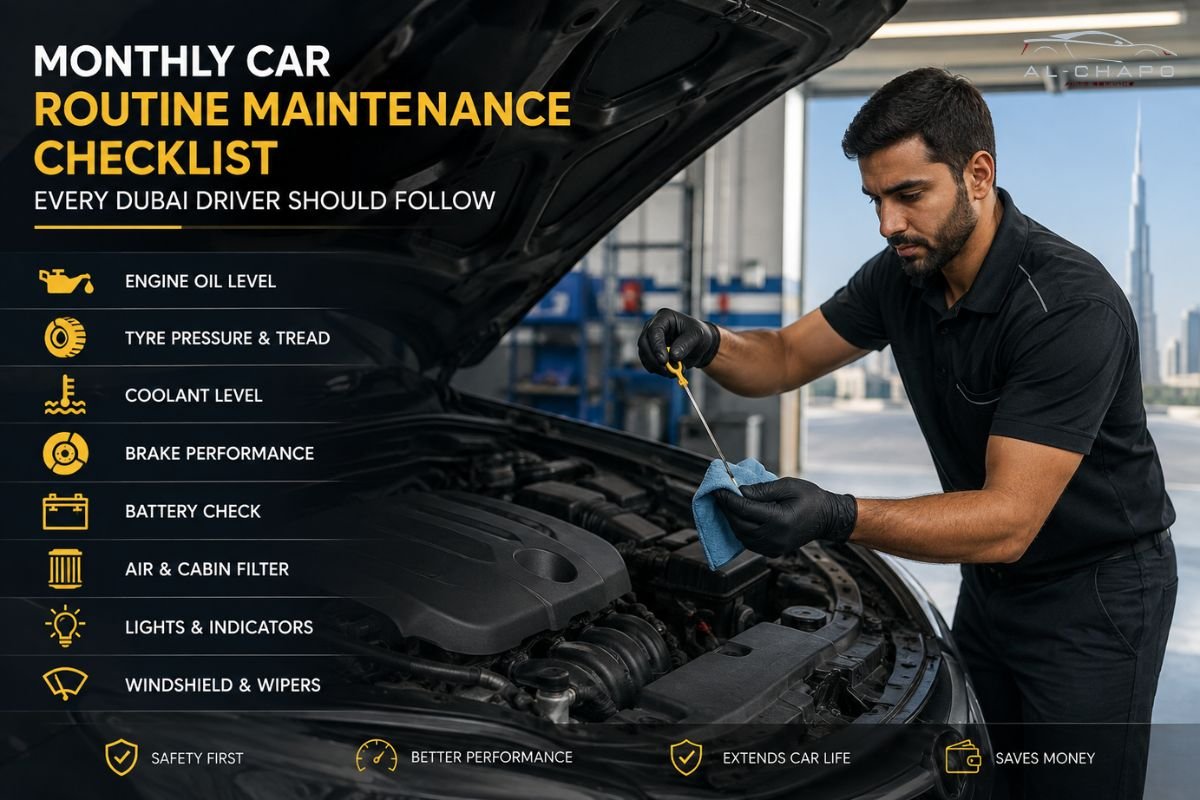
This is the core routine. Not every item needs a workshop visit, but if you’re a high-mileage driver, most of them benefit from a professional set of eyes at least once a month.
| Component | What to Check | Why It Matters in Dubai |
| Engine oil | Level and colour | Heat thins oil faster, reducing lubrication |
| Coolant | Level, colour, leaks | Overheating risk is higher in summer traffic |
| Battery terminals | Corrosion, tight connection | Heat shortens battery lifespan significantly |
| Brake fluid | Level and clarity | Frequent stop-start traffic wears brakes faster |
| Tyres | Pressure, tread depth, alignment | Hot roads cause uneven wear and blowout risk |
| AC system | Cooling performance, odd smells | AC failure is one of the most common Dubai complaints |
| Air filter | Dust build-up | Sandy roads clog filters faster than usual |
| Lights and wipers | Function check | Sandstorms reduce visibility fast |
If two or three of these are off, it’s worth booking a car repair and maintenance service in Dubai instead of waiting for the next scheduled interval. Small issues compound fast in this climate.
Comparing DIY checks vs professional inspection
| Task | Can You Do It Yourself? | Recommended Frequency |
| Tyre pressure | Yes | Weekly |
| Visual fluid check | Yes | Monthly |
| Oil change | No, needs proper disposal and equipment | Every 5,000–8,000 km |
| Brake inspection | Partially (visual only) | Monthly, professional every 3 months |
| AC diagnostics | No | Every 6 months, or at first sign of weak cooling |
| Wheel alignment | No | Every 10,000 km or after hitting a pothole |
| Full vehicle inspection | No | Annually, or before RTA renewal |
Moreover, this isn’t meant to talk anyone out of checking their own tyres and fluids; that habit is genuinely useful. It’s more about showing where a trained technician catches things a glance won’t.
Common maintenance mistakes Dubai drivers make
- Assuming synthetic oil buys you longer intervals, full stop- Synthetic oil does handle heat better, but Dubai’s driving conditions, the traffic, the dust, the short trips, still shorten the practical interval below what the label promises.
- Ignoring the AC until it stops working entirely- A weak AC is a warning sign, not a minor annoyance. Refrigerant leaks, a failing compressor, a clogged cabin filter- all of these show symptoms well before total failure.
- Skipping coolant checks because “the gauge looks fine.”- By the time the gauge moves, the damage may already be underway. Coolant checks work better as a habit than a reaction.
- Putting off brake pad replacement- Stop-start traffic on roads like Al Ittihad or Sheikh Zayed wears pads down faster than steady highway driving would. Wait for the squeal, and there’s a decent chance the rotor is already scored.
- Treating a battery warranty like a maintenance plan- A warranty gets you a new battery after it dies. It does nothing about the breakdown that happens on the way to the shop.
What does a professional service actually cover?
A good workshop visit consists of more than what you can see from the hood. The technicians generally perform diagnostics on the onboard computer, review fault codes, and examine other inaccessible elements, including bushings, exhaust mounts, rust, and sand damage
The car oil change service Dubai that car owners schedule every month, or every few months (depending on the mileage), is essentially different from oil draining and refilling. Most decent shops also check the oil filter, look for leaks around the pan gasket, and inspect the drive belts while the car’s already up on the lift, since that’s the easiest moment to spot one starting to fray.
Separately, vehicle inspection services in Dubai are required every year for RTA registration renewal, but treating that as your only inspection is a mistake. A pre-renewal check catches problems at the last possible moment, by which point a small issue may already have grown into a bigger one.
Expert insight
Most drivers wait for a dashboard light before doing anything, but by then the problem’s usually been building for weeks. A slightly longer crank before the engine starts. A faint burning smell near the AC vents. Minor vibrations in the steering wheel when driving at high speeds and strange sounds while driving may seem unimportant, but could indicate that something is wrong. If you ignore these early signs, it can result in costly repairs later.
Most drivers normally wait until something breaks before contacting a service center. However, early detection of minor problems is always faster and cheaper than waiting for bigger failures. A small maintenance routine each month will enable you to detect minor problems before they become serious ones.
Bottom line
A monthly maintenance habit doesn’t need to be complicated. Check tyres and fluids weekly, run through the fuller list monthly, and don’t wait for a warning light before booking a proper inspection. Dubai’s climate isn’t gentle on cars, but a car that gets checked regularly rarely breaks down without warning first.
If you’d rather hand the monthly checks to a trained technician than guess your way through them, Alchapo Auto Service runs scheduled car routine maintenance services in Dubai built around exactly this kind of climate-adjusted routine. Worth booking before the next long summer stretch, not after something’s already gone wrong.
Frequently asked questions
Full service is required every 5,000 – 8,000 km, and monthly checks on fluids and tyres are advisable in this hot and dusty environment.
It’s a good idea. Synthetic oil performs better than conventional oil in high-temperature applications, but can still be used for heavy-duty use.
If the temperature is not dropping significantly during extremely hot weather, it can indicate a refrigerant leak, compressor failure, or clogged cabin filter. Check it up before it breaks.
Typically around 2-3 years, less than in cooler climates due to consistent heat causing internal degradation of the battery.
It is a good practice to conduct a visual inspection once a month. Pads wear out quicker here, so a professional look every 3 months also is worth adding.
Typically, inspections include brakes, tyres, lights, emissions, steering, and suspension, which are needed every year for RTA registration renewals.
Yes. In Dubai, dust accumulates in the air filters more rapidly, which will cause the filters to become clogged and make it harder for the engine to breathe if the filters are not replaced when needed.
Yes, definitely for longer journeys. Simple checks (low oil or coolant, worn tires) can prevent situations from getting out of hand on the road.