
Best Materials for Car Body Kits: Fiberglass vs Carbon Fiber vs Polyurethane
Table of Contents
- Key Takeaways
- Why does material choice matter more than design?
- Fiberglass body kits: strengths and trade-offs
- Carbon fiber body kits: performance at a price
- Polyurethane body kits: built for daily durability
- Side-by-side comparison
- Which material suits Dubai’s climate best?
- Common mistakes car owners make
- Expert recommendations
- Bottom line
- Frequently asked questions
Key Takeaways
- While fiberglass is inexpensive and functional, it must be properly maintained to avoid breakage.
- Carbon fiber offers sturdy, lightweight properties but comes with a price tag.
- Polyurethane does not crack and, therefore, is great for everyday driving and rough terrain.
- The choice of spoiler material should be determined by driving style rather than its looks.
When it comes to body kits, it’s not simply about aesthetics. It is a choice that will impact weight, repair costs, heat resistance, and years of daily use. When looking for car body kits in Dubai, people have one question, and that is, “what are they?” The stress on body kits is greater than most manufacturers can imagine in Dubai’s climate, road conditions, and driving habits.
Each of fiberglass, carbon fiber, and polyurethane has different heat, impact, and wear properties. A showroom picture might look the same, but describe the same model after six months in Dubai summers, and it could be completely different! This guide provides an explanation of the features of each material, its limitations, and which one is appropriate for a given usage of the car.
Why does material choice matter more than design?
Many customers are preoccupied with the appearance of a bumper or the aggressiveness of a spoiler, with the construction of the bumper last. I can see why it’s the way it is, but it’s wrong. The material will make the difference in terms of whether the kit resists a parking bump, warps in direct sunlight, and can be repaired rather than replaced.
Furthermore, Dubai has additional factors that are not addressed by most guides. In summer, surface temperatures of asphalt can be more than 60°C. Surface wear is expedited by sand and grit. In most neighborhoods, speed bumps and parking restrictions are commonplace. What works great in a cooler climate doesn’t work well here!
How does heat affect different materials?
Heat isn’t the only cause of paint fading. It’s a problem with the glue and the resin used to construct a body kit. Under extreme heat, some materials are slightly softened and will regain their shape when they are cooled. Some others become brittle when heated over and over again, and show up as minute cracks around the mounting points after a year or two.
Fiberglass body kits: strengths and trade-offs
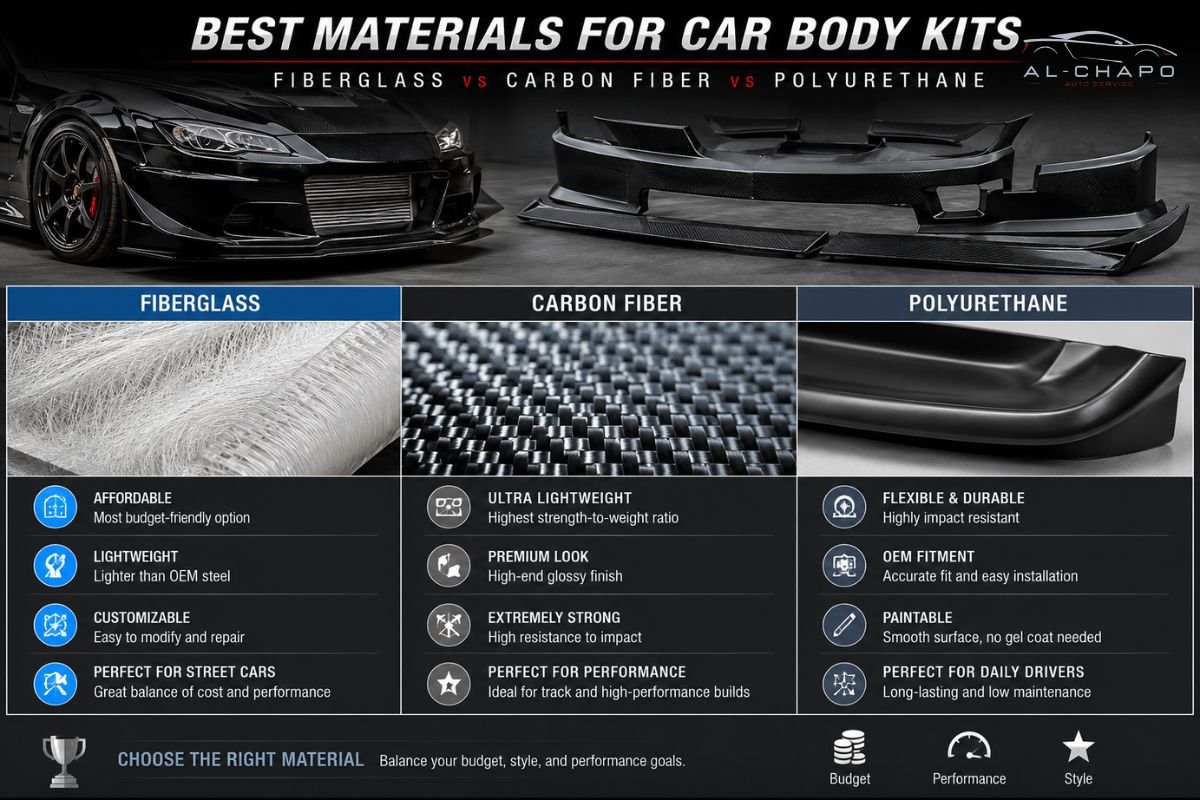
Fiberglass after market body kits are the go to material for after market body kits for decades and there is a reason for that. It doesn’t cost too much to make, is easy to shape, and is found in almost any popular vehicle style.
Where does fiberglass perform well?
For those looking at a broad-band appearance, custom lip kits or aggressive aesthetics, fiberglass is the cheapest choice. It is also easy to paint, as it is for those who prefer a factory-matched exterior.
Where does fiberglass fall short?
The downside comes as a result of the passage of time. Fiberglass is rigid; it won’t bend when struck. A parking bump or minor curb scrape that a polyurethane bumper would only take a small dent on can crack a fiberglass bumper. There may be some repairs, but they will involve sanding, resin work, and repainting, which is not cost-effective.
Fiberglass may also become just a little bit brittle each summer if it has not been made of UV-stabilized resin, especially in the heat of Dubai. Quality control in manufacturing is as important as the material itself, which is one reason.
Carbon fiber body kits: performance at a price
Carbon fiber is the material we all associate with high-performance and luxury cars, and it is not only for looks. It’s not just for looks; carbon fiber is the material we all associate with high performance and luxury cars for good reasons.
The strength-to-weight advantage
Carbon fiber is much lighter than fiberglass or polyurethane and has a greater tensile strength. For the performance-minded owners, it can make a real impact on handling and acceleration, particularly on items such as hoods, diffusers, and spoilers.
The real costs involved
The price of that performance is not only the initial one, but also the maintenance one. The cost of carbon fibre components in production and proper installation is significantly higher. The precision of the fitment is to be noted because, if the installation is not made correctly, the poor fitment would be much more visible and much more costly on a carbon fiber panel than on fiberglass.
Carbon fiber requires particular care. If not well protected against the effects of exposure to the sun, the clear coat may become faded over time, and its repair is usually a composite job, not a bodywork job. The extra expense may not be worth it to owners who don’t need the performance.
Where does carbon fiber make sense?
It’s most suitable for performance and luxury cars where weight reduction is really important or for people who want the authentic woven appearance and are willing to take the time to keep it in good condition.
Polyurethane body kits: built for daily durability
Though not as popular as carbon fibre, in everyday use, polyurethane seems to be the most sensible choice.
Flexibility over rigidity
Flexibility is the key characteristic of polyurethane. Rather than break on impact, it will bend and spring back into shape. This makes it much more suitable to the actual driving environment, such as parking mishaps, speed bumps, and the brief contacts usually seen in heavy urban traffic.
Why does this matter for daily drivers?
If you are not using your car as a weekend or show car, then polyurethane is a sign of durability and will directly affect the cost of repairs over time. It also has good temperature resistance, which is important because of the difference between a garage sheltered from the sun and the temperature during the hottest part of the day.
The trade-offs
The weight of polyurethane is higher than fiberglass and much higher than carbon fiber. It may also be slightly more challenging to get a perfect paint job compared to fiberglass, which needs certain types of primers to ensure that the paint doesn’t crack or flex away from the material it’s attached to.
Side-by-side comparison
| Factor | Fiberglass | Carbon Fiber | Polyurethane |
| Impact resistance | Low – cracks on impact | Moderate – strong but brittle | High – flexes and recovers |
| Weight | Light | Lightest | Heaviest |
| Cost | Lowest | Highest | Mid-range |
| Heat tolerance | Moderate | Good with protection | Good |
| Repair complexity | Moderate | High – specialized work | Low |
| Best suited for | Show cars, custom styling | Performance/luxury vehicles | Daily drivers |
Which material suits Dubai’s climate best?
There is not a single right answer, but there are patterns to know. Polyurethane lasts longer over time for those who commute daily and find parking, speed bumps, and stop-and-go traffic troublesome. Carbon fiber may not be the best bet for owners who want to save weight and don’t mind storing the car and paying attention to it in the garage, even considering the high price.
Additionally, fiberglass is still relevant in some situations, especially for those who are looking for styling versatility and cost – as long as expectations for durability are grounded. A trusted car body kit service in Dubai will typically guide their customers through this choice in a straightforward and forthright manner and won’t try to sell what would make the most profit.
Why does local expertise matter?
Climate-specific guidance can only be acquired from experience in the local climate. A regular car body kit shop will be familiar with the types of resin that will resist years of UV exposure and how to avoid the cracking of the resin in the vicinity of high-heat areas such as the wheel arches or engine bay.
Common mistakes car owners make
- Selecting a material for its initial price with no consideration of repair expenses in the future.
- When there’s a wide range of resin quality from different manufacturers and all fiberglass kits are assumed to be alike.
- Skipping professional car body kit installation Dubai services to save money takes a toll on the panels, alignment, and cracking.
- Not considering paint compatibility – particularly paint compatibility with polyurethane, which most body shops do not carry flexible primers for.
Failing to ask before purchase about UV-stabilised materials – especially important in Dubai where there is a high level of UV exposure.
Expert recommendations
When comparing options, request what type of resin or composite grade is being used, rather than simply what the completed kit is going to look like. A quality installer will have no problem explaining the difference between standard fiberglass and UV-stabilized fiberglass, and cosmetic carbon fiber layups versus structural carbon fiber layups.
At Alchapo Auto Service, the material talk always precedes the styling talk; the reason being, the wrong material for a Dubai-driven vehicle generally costs more in the long run than it costs initially. When you match material to driving style, and not merely appearance, you get better results for customers, every time.
If the business owner would rather not deal with these trade-offs for material-specific expertise for the installation of car body kits, then measurable differences would be felt three or five years later, depending on the quality of the Car body kits Dubai shop that performs the work.
Bottom line
The question of which material is the “best” between fiberglass, carbon fiber, and polyurethane is open to everyone. They all address a different set of issues, and the best option is based on a car’s usage, its parking requirements, and its owner’s priorities among cost, weight, and durability. The important thing is to do it using credible data and not marketing hype.
However, still not sure what material you should opt for in your car and for your driving? Don’t waste money on a body kit that will be wrecked by Dubai roads until you get an honest and experience-based recommendation from Alchapo Auto Service.
Frequently asked questions
Polyurethane is recommended as the most suitable material for standard use, as it is capable of flexing on impact without cracking and is ideal for Dubai’s roads and parking conditions.
If the vehicle is a performance or luxury car where weight is a factor, it’s worth it, but not if the only reason is for looks and not the benefit it provides.
The quality of the fiberglass is more important than the material itself because standard fiberglass is brittle after repeated heat cycles if it is not manufactured with UV-stabilised resin.
Yes, but they need flexible primers for the material, or the paint can break off from the panel below it.
Carbon fiber is the strongest of all materials and is the most commonly used material for hoods, spoilers, and other parts that are important for performance.
Significantly. Misaligned or mis-installed material can be one of the most common reasons for cracking, regardless of the type of material.
Absolutely, polyurethane has a higher mass than fiberglass and carbon fibre, but this is a compromise for its greater flexibility and impact resistance.
Polyurethane can be used for daily drivers, as it will not crack under curbs, speed bumps, or minor impacts.
Yes, they need UV protection for the clear coat and special composite repair techniques if they become damaged as opposed to conventional bodywork.
The actual performance of the car should also be considered; the choice will depend on how it is driven on a daily basis, rather than its outward appearance, as each material has its own way of working for real-life use.