
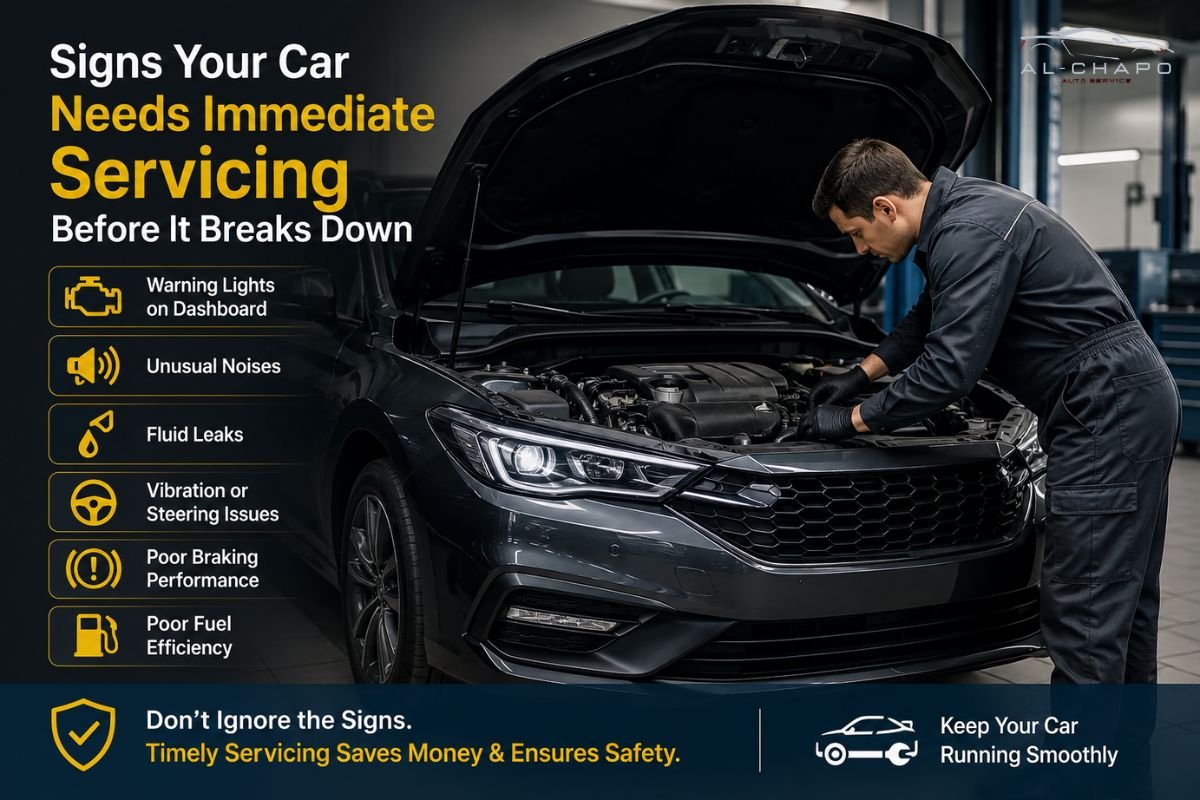
Signs Your Car Needs Immediate Servicing Before It Breaks Down
Table of Contents
- Key Takeaways
- Why do cars break down without warning (except they don’t)?
- Dashboard warning lights you should never ignore
- Strange noises that mean trouble
- Fluid leaks and what they’re telling you
- Braking problems you shouldn’t drive with
- Engine performance issues to watch for
- Why does regular vehicle inspection catch problems early?
- Common mistakes drivers make
- Expert recommendations
- Wrapping it up
- Frequently asked questions
Key Takeaways
- Most of the time, cars display alerts before suddenly malfunctioning if detected in time.
- The dashboard lights, a strange sound, as well as leaks can be signs of problems in the car mechanics caused by a malfunction.
- Regular maintenance services in Dubai can help avoid costly repairs by carrying out regular maintenance work on the vehicle.
- Car diagnostics in Dubai allow for the identification of issues that have yet to lead to severe damage.
Cars rarely fail without giving some kind of warning first. Usually there are signs days, sometimes weeks, before you end up stranded on Sheikh Zayed Road or standing next to a car that won’t start in a parking lot. Most drivers just don’t catch these signals in time. A rough idle gets written off as nothing. A faint burning smell goes unnoticed because the AC is running and the windows are up. Then the car actually stops working, and what was a five-minute fix a month ago is now a repair bill you didn’t plan for.
We see this a lot at Alchapo Auto Service. Cars come in for emergency repairs that never needed to be emergencies, and in almost every case, regular car routine maintenance services in Dubai would have caught the problem early. This article goes through the specific warning signs worth paying attention to, and why acting on them now rather than “eventually” saves you money and a fair amount of stress.
Why do cars break down without warning (except they don’t)?
Dubai isn’t an easy place to own a car, mechanically speaking. The heat alone puts constant strain on engines, batteries, and cooling systems, and that’s before you factor in long highway stretches and the stop-start crawl of rush hour traffic. A car that would coast along fine for years somewhere cooler can start showing wear here much sooner if it’s skipping service intervals.
Breakdowns aren’t sudden. They’re what happens after a small issue sits unaddressed for too long. A battery that’s been getting weaker for months. A belt fraying quietly under the hood. Coolant dropping a little at a time without anyone noticing. Your car gives you plenty of chances to catch these things before they turn into a roadside problem. Learning to notice them is really the whole game.
Dashboard warning lights you should never ignore
Every modern car is packed with sensors watching almost everything happening under the hood. When something drifts outside its normal range, a light comes on. Ignoring it is one of the most common mistakes drivers make, and one of the easiest to avoid.
- Check Engine Light
This one gets a bad reputation because it covers so much ground. Sometimes it’s genuinely minor, like a fuel cap that wasn’t tightened properly. Other times it’s pointing to a failing sensor or something more serious with the engine itself. Either way, it shouldn’t sit ignored for more than a day or two. A car diagnostic scanner Dubai reading will tell you exactly what triggered it instead of leaving you to guess.
- Battery and Charging System Light
If this comes on while you’re driving, there’s a good chance your alternator isn’t charging the battery the way it should. Ignore it long enough, and the car can lose power entirely, sometimes while you’re sitting in traffic.
- Oil Pressure Light
Low oil pressure could mean the oil level is simply low, or it could mean the oil pump is failing. Neither is worth gambling on. Driving with this light on risks real engine damage within minutes, not hours.
- Temperature Warning Light
An overheating engine causes damage fast, and some of it is permanent. If this light turns on, find somewhere safe to pull over as soon as you can.
Strange noises that mean trouble
Vehicles are known to produce some sounds; however, it is the unusual ones that should always be monitored, as they often signal the need for something. Brakes making squealing sounds may indicate brake pads that are worn out. Clunking sounds while going over bumpy roads can indicate issues with suspension.
A ticking noise coming from the engine may be a sign of a low level of oil or defective engine parts. A squealing sound occurring upon starting the engine can be caused by a loose or slipping belt. Hissing sounds may indicate leakage in the cooling or vacuum system. Fixing these issues on time can prevent bigger problems in the future, as well as keep the cost of repairs to a minimum.
Fluid leaks and what they’re telling you
A puddle under a parked car is never just water. The color and where it’s pooling will usually tell you what’s leaking.
| Fluid | Color | Likely Source |
| Engine oil | Brown or black | Oil pan, gasket, or seal |
| Coolant | Green, orange, or pink | Radiator, hose, or water pump |
| Brake fluid | Light yellow to amber | Brake lines or master cylinder |
| Transmission fluid | Red or reddish-brown | Transmission seals or pan |
| Power steering fluid | Reddish or light brown | Steering system hoses |
If you spot any of these, brake fluid especially, get it looked at right away instead of waiting for your next scheduled visit.
Braking problems you shouldn’t drive with
Brakes aren’t something to shrug off with “it still kind of works.” Watch out for a soft or spongy pedal, the car pulling to one side when you brake, vibration coming through the steering wheel or pedal, a burning smell after repeated braking, or stopping distances that feel longer than they used to.
However, any single one of these is reason enough to get vehicle inspection services in Dubai booked before you head out on a long drive.
Engine performance issues to watch for
Beyond the lights and the noises, pay attention to how the car actually feels when you’re driving it.
- Rough Idling or Stalling
If the engine shakes noticeably while stopped, or cuts out without warning, that usually comes down to a fuel delivery or ignition problem.
- Reduced Fuel Efficiency
If your mileage drops off suddenly and your driving habits haven’t changed, something in the engine or exhaust system likely isn’t running as efficiently as it should.
- Difficulty Starting
Slow cranking, or needing a few tries before the engine catches, is often one of the earliest signs of a weakening battery or starter.
- Loss of Power on Acceleration
A sluggish or hesitant feel when you press the accelerator can come from something as simple as a clogged air filter, or something bigger like a failing fuel pump.
Why does regular vehicle inspection catch problems early?
This is really where most of these issues get stopped before they start. Car repair and maintenance service in Dubai isn’t just about oil changes on a calendar. A real inspection covers brakes, belts, fluid levels, battery health, and tire condition, giving you an actual picture of your car’s condition rather than a guess.
At Alchapo Auto Service, every inspection includes a full car diagnostic scanner Dubai check, so electronic and sensor issues get caught even when there’s no obvious symptom yet. That matters more with newer cars, where a lot of what’s going wrong simply isn’t something you can hear or see from the driver’s seat.
Moreover, vehicle inspection services in Dubai are also required for registration renewal, so it’s easy enough to combine a mandatory check with an inspection that’s actually useful for your car’s health.
Common mistakes drivers make
Waiting for a warning light to switch off on its own is a common one, and it won’t happen. The light stays on until whatever triggered it gets fixed. Assuming a strange noise will improve with time is another; mechanical wear doesn’t reverse itself. Some drivers top up fluids without ever finding where the leak is coming from, which just delays the real fix.
Furthermore, others skip scheduled maintenance because the car “feels fine,” even though a lot of issues develop internally long before they’re noticeable while driving. However, going with the cheapest repair option without checking the actual cause tends to mean paying for the same problem twice.
Expert recommendations
Over the years, there have been some badges that allow people to distinguish between cars that are keeping their cars up and running and those that aren’t. There are a few habits that get a few cars across Dubai’s roads and climate without a problem, vs others. Car routine maintenance services in Dubai should be provided approximately every 5000-10000 kilometers, depending on the car’s type and usage.
Do not delay a diagnostic scan, even if the car is driving normally, when a warning light is on. Make sure to check fluids at least once every month, and especially before embarking on a long trip. Have brakes checked every six months or more frequently if most of the driving is done in urban areas. Maintain a Service Record. It simplifies the detection of patterns in wear and repairs in the long term.
Wrapping it up
A car is constantly communicating through its lights, sounds, smells, and the general feel of how it drives. Those who don’t have a breakdown aren’t necessarily driving newer cars or getting lucky. It’s they who see these signs and take action. Routine maintenance services in Dubai for cars are the best way to solve small problems early and ensure the driver’s car is reliable for years to come.
If you are experiencing any of these symptoms mentioned in this blog, then it is good to have it checked before it becomes worse.
Don’t wait until it’s too late- schedule a full inspection with Alchapo Auto Service today and receive a comprehensive diagnostic check in advance.
Frequently asked questions
This is about every 5,000 to 10,000 kms, depending on your specific make, model, and driving style- especially the heat and traffic in Dubai.
Extracts fault codes from the car’s onboard computer system, which includes the engine, transmission, brakes, and other electronic systems, before they show up outside the vehicle.
It’s okay for a short trip, but shouldn’t be left longer than a day or two without getting it scanned, just in case it’s serious.
Any squealing, soft pedal, longer braking distance, or vibration as the brakes rub should be a sign that it’s time for an inspection.
Many times it’s due to a clogged air filter or old spark plugs, low tire pressure, or something went awry with the fuel or exhaust system.
Brakes, fluids, battery, belts, suspension, tyres, and diagnostic scan to detect electronic problems that can’t be seen.
Leaks of brake fluid and coolant should be repaired immediately. Additionally, check for oil leaks soon, as low oil can cause the engine to be ruined in a hurry.
It’s almost always a weak or old battery, and Dubai’s climate is just as likely to take the battery life as a milder climate would be.
Yes, for the most part. The majority of failures begin at a small level and remain visible for some time until they develop into a roadside failure.
Alchapo Auto Service provides diagnostic checks, inspections, and car maintenance in Dubai for all vehicle brands and models.