
Common Car AC Problems in Dubai and How to Prevent Them
Table of Contents
- Key takeaways
- Why does Dubai’s heat push car AC systems to the limit?
- Common signs your car AC is failing
- Top car AC problems explained
- Simple prevention tips every driver should follow
- When should you call professional help?
- Choosing the right car workshop
- Cost comparison of common AC repairs
- Bottom line
- Frequently asked questions
Key Takeaways
- In Dubai, the extreme conditions can make air conditioning units break down faster than some people may think, which means that annual check-ups are necessary here.
- Problems with airflow and unusual sounds occur long before your car stops working entirely.
- Getting gas is a lot cheaper than replacing the compressor afterward.
- A garage has the diagnostic tools for finding scratches before you are stuck in the middle of Sheikh Zayed Road in extreme heat.
If you’ve ever sat in Dubai traffic while your AC blows lukewarm air at you, you know exactly how fast the mood can shift. It’s not a minor inconvenience. With summer temperatures climbing well past 45°C, a working AC system stops being a comfort feature and becomes something closer to a requirement. Therefore, yet most people only start paying attention to their car’s AC once it’s already failed, usually somewhere inconvenient, usually at the worst time.
Here’s the thing though- most AC problems in this city follow a pattern. Majority of car AC issues are common and can be avoided with routine maintenance. This guide covers the most common AC problems, what causes them, and when you should get professional AC repair rather than attempting to solve the problem yourself.
Why Dubai’s heat pushes car AC systems to the limit?
Dubai isn’t gentle on cars, and the AC system takes more of that punishment than people give it credit for. Between the heat, the humidity swings, and the fine dust that gets into everything, these systems are working conditions they weren’t really built for.
A few reasons your AC is under more strain than it should be:
- The high temperatures in Dubai put a lot of strain on the air conditioning system of the car.
- In order to keep the interior cool at high temperatures, compressor must work harder.
- A very short time is enough for dust and sand to block the air filter and the condenser and lower the cooling efficiency.
- Hours spent stuck in traffic make the air conditioner more prone to damage.
- Prolonged exposure to heat may also harm rubber seals and hoses.
Therefore, it is important to make sure that a professional car repair and maintenance service in Dubai provides thorough AC inspection in addition to a routine check-up of the engine. Skip that step and you’re basically gambling that nothing goes wrong before July.
Common signs your car AC is failing
AC systems rarely fail out of nowhere. There’s almost always a stretch, days or sometimes weeks, where something feels slightly off before it gives out completely. Catching that window is the whole game.
Keep an eye out for:
- Air that stays warm even with the AC cranked to max
- Airflow that feels weaker than usual or comes and goes
- A musty smell the moment you turn the AC on
- Clicking, rattling, or squealing sounds from under the dash
- Windows fogging up despite the AC running
- Water pooling near the front passenger footwell (this one surprises people)
- The compressor kicking on and off more often than it should
If your car has any of these issues, get it checked out before you going to the road for an extended trip.
Top car AC problems explained
Understanding the issue allows you to make a more informed decision when your mechanic is explaining the fix. These are the usual car AC problems found in Dubai with the help of car diagnostic scanner Dubai.
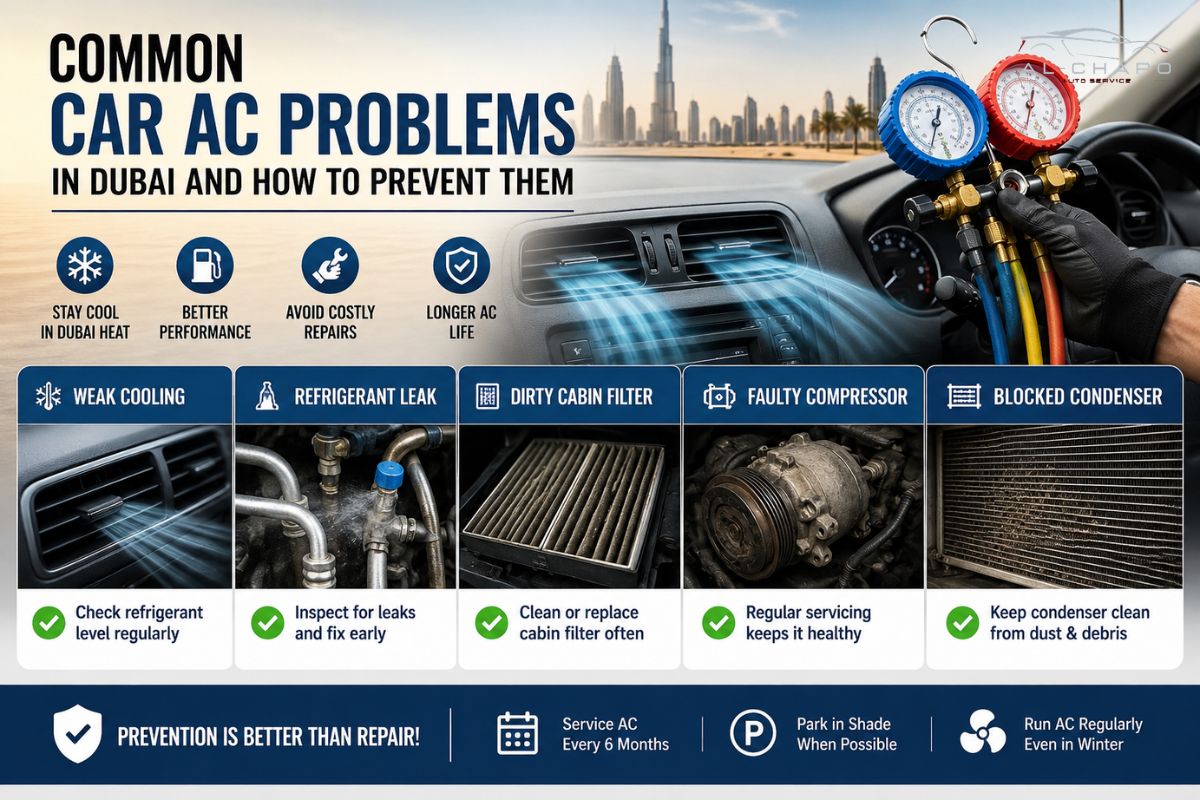
1. Refrigerant leaks
Small leaks around hoses, seals, or the condenser reduce cooling gradually, and if refrigerant levels drop too far, they can end up damaging the compressor too.
2. Compressor failure
The compressor does most of the heavy lifting, and constant heat plus long hours of use makes it the part most likely to fail here. Replacing it is usually the priciest AC repair a car owner faces.
3. Clogged condenser
Dust and sand accumulate on the fins of the condenser over time, thereby obstructing airflow and resulting in an inefficient cooling of the refrigerant.
4. Faulty blower motor
Even if the other components are working well, a defective or weak blower motor will still lead to poor airflow.
5. Electrical issues
Bad wiring, blown fuses, or malfunctioning relays may keep the AC unit from working properly.
6. Dirty cabin air filter
People tend to forget this aspect very often. The restricted airflow as a result of dirty filters will contribute to bad smells, even if everything else in the system is functioning as it should.
Simple prevention tips every driver should follow
Regular upkeep is the best way to prevent costly AC repairs. Following a simple habits can help your car’s AC system survive and work efficiently for many years.
- Run your cars AC for about 10 minutes a week to keep the compressor in good shape.
- Change the cabin air filter every 12,000-15,000 km, or more frequently if you travel in dusty conditions.
- Whenever you can, park your car in the shade or under some kind of cover to minimize heat buildup inside the car.
- Have refrigerant levels checked once a year, minimum.
- Open the windows for a moment before turning the AC once you start the car.
- Book a proper AC inspection before summer really kicks in.
- Crack the windows slightly when parked to let some heat escape.
None of this is complicated. It’s mostly just remembering to do it, which is honestly the hardest part.
When should you call professional help?
Some warning signs can wait a few days. Others can’t. A sudden drop in cooling, a burning smell, refrigerant visibly leaking, or loud grinding noises mean stop putting it off and get it looked at.
Modern cars lean heavily on sensors and electronics for climate control, so guessing what’s wrong tends to backfire. That’s where a real car diagnostic scanner Dubai workshops use makes a genuine difference. It pulls the actual fault code instead of having a technician swap parts and hope. That alone saves both time and money.
Furthermore, good car AC repair services in Dubai almost always start with a diagnostic scan before anyone touches a component. If a workshop skips straight to guessing, that tells you something.
Choosing the right car workshop
Not every workshop handles AC work well, and honestly, that’s fine to say out loud. Refrigerant handling, electrical diagnostics, and precise pressure calibration take real expertise, so the shop you pick matters more here than for most other repairs.
Look for these things before you commit:
| What to Check | Why It Matters |
| Proper diagnostic equipment | Finds the actual fault instead of guessing |
| Certified refrigerant handling | Avoids leaks and keeps things compliant |
| Transparent pricing | No surprise charges once the job’s done |
| Genuine or OEM-grade parts | Repairs tend to actually last |
| Warranty on AC work | You’re covered if the issue comes back |
| Experience with your car’s make | Some systems need brand-specific tools |
Alchapo Auto Service is one workshop that fits this checklist, running diagnostics first and being upfront about pricing rather than pushing parts you might not need. Whether it’s a small gas top-up or a full compressor swap, working with a shop that actually explains the problem before jumping to a fix saves you money and a fair amount of stress.
If you’re weighing your options, it’s worth asking whether a shop calling itself the best car workshop in Dubai actually backs that up with diagnostic capability and technician experience, and not just a well-designed website.
Cost comparison of common AC repairs
Prices shift depending on your car and the workshop, but here’s a rough sense of what to expect:
| Repair Type | Approximate Cost Range (AED) | Typical Turnaround |
| Refrigerant top-up | 150–350 | Same day |
| Cabin air filter replacement | 80–200 | Under 1 hour |
| Condenser cleaning | 100–250 | Same day |
| Blower motor replacement | 300–700 | Same day |
| Compressor replacement | 1,200–3,500 | 1–2 days |
| Full AC diagnostic scan | 100–250 | 30–45 minutes |
That gap between a top-up and a full compressor replacement is the whole argument for catching problems early.
Bottom line
Your car’s AC deserves the same attention you’d give your engine oil or your brakes, maybe more, given what Dubai summers do to it. A seasonal checkup, a filter swap, and paying attention to the early signs can be the difference between a smooth drive and being stuck in traffic with no cold air and a repair bill you didn’t budget for.
If the AC in your car isn’t blowing cold air, don’t just accept it. Have it looked at by a professional to find and fix the problem before the heat gets worse. Addressing the issue early can save you from expensive repairs and more comfortable drives every day.
Frequently asked questions
Once a year; better if just before summer. This is done in order to diagnose leaks and broken components before they result in expensive breakdowns during summer.
It could either be due to lack of refrigerant, malfunction of the compressor or failure in electrics. A computer diagnostic will be the quickest way to find out which of them is the reason.
No. This is an indicator for mold or bacteria being present in the evaporator or for the cabin filter being dirty and needing to be cleaned or replaced.
The price usually lies between 1200 and 3500 AED, depending on the model of the car, used parts and if OEM or aftermarket parts are used.
Recharging your car’s AC is not something you want to do without the right tools and knowledge. The compressor can be damaged if the refrigerant charge is incorrect, so it is always best to take help from a professional technician.
Common causes like clogged cabin air filter, bad blower motor, or blocked air vents. Such obstacles restrict airflow and stop cool air from getting to the cabin as it should.
If the system does not cool correctly, a warning light will come on, or the repairs made previously have not resolved the problem, the scan can be used to determine the cause.
Yes, as the high temperatures, dust, and sitting in traffic exhaust the compressors and seals more than in any other cities with pleasant climate.